
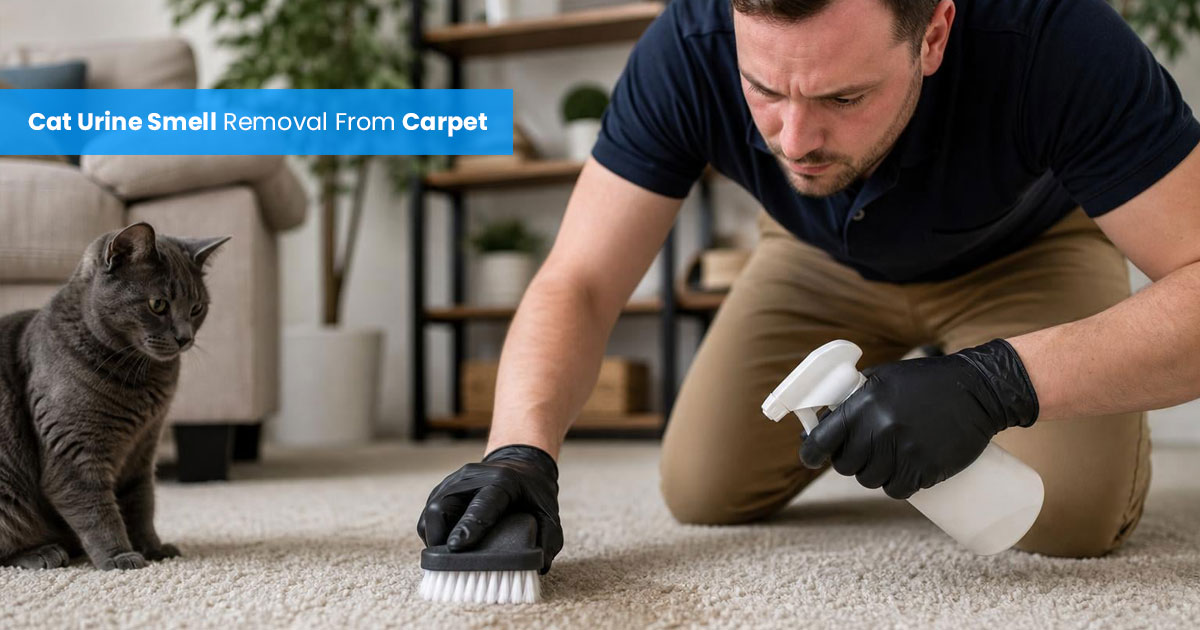
How To | Cat Urine Smell Removal From Carpet (2026 Guide)
TLDR
Cat urine smell removal from carpet only works when the cleaning method reaches the same depth as the urine. An enzyme cleaner is usually the best first step because it breaks down urine compounds instead of masking them. If the urine has soaked into the underlay or subfloor, surface cleaning will fail, and you may need professional extraction or carpet replacement. Recurring accidents also need a vet check, because inappropriate urination is often medical.
Cat urine smell removal from carpet is not about making the room smell nicer for an hour. It means removing urine residue from the carpet fibres, backing, underlay, and sometimes the subfloor underneath. That is why the smell can return after the carpet looks clean, especially during humid weather, after rain, or following another round of water-only cleaning. The Carpet and Rug Institute puts it plainly: complete odour removal is unlikely unless the cat urine is completely removed from the carpet system (Source).
This guide explains the key terms you will encounter when trying to fix this problem, walks through what actually works (and what makes things worse), and helps you decide whether DIY treatment, professional cleaning, or replacement is the right call.
Why Cat Pee Smell Keeps Coming Back
The stubbornness of cat urine odour comes down to chemistry and depth.
When a cat urinates on carpet, the liquid contains urea, creatine, uric acid, sodium chloride, and various electrolytes. As bacteria break down the urea, they produce ammonia, which is responsible for that sharp initial smell. Over time, further decomposition can release mercaptans, compounds associated with a skunk-like odour (Source). So old cat urine does not just smell the same as fresh cat urine. It actually smells worse.
The real problem, though, is not the chemistry on the surface. It is the depth.
Urine is a liquid. It follows gravity. On carpet, it moves downward through the fibres, into the backing, through the underlay (also called the carpet pad), and can reach the subfloor beneath. Every absorbent layer it touches holds residue. When you spray a cleaner on top and wipe the carpet fibres, you may clean the shallowest 10% of the contamination while leaving the remaining 90% untouched.
This is why humidity and moisture bring the smell back. The Carpet and Rug Institute notes that products which only mask odour can seem effective until high humidity reactivates the residue underneath (Source). The smell is not “coming back.” It never left. It was just below the surface, waiting for moisture to carry it upward again.
If the room smells like cat urine after the carpet looks clean, the issue is almost always residue trapped deeper than the last cleaning reached. Surface cleaning alone, including vacuuming and basic carpet maintenance, simply cannot address contamination that has moved into lower layers.
Glossary of Cat Urine Carpet-Cleaning Terms
These definitions are not academic. Each one connects to a real decision you need to make when dealing with cat urine in carpet.
Cat urine odour
The strong ammonia-like (and eventually skunk-like) smell produced as cat urine decomposes. PetMD explains that the odour develops as bacteria break down urine and can worsen over time as mercaptans are produced (Source). Why it matters: if the smell is still there, the urine residue is still there somewhere.
Uric acid crystals
Low-solubility residue that remains after the water in urine evaporates. Standard soap, vinegar, deodoriser, or carpet shampoo may reduce the smell temporarily, but uric acid crystals can persist in porous materials like carpet, underlay, and wood. A carpet cleaning practitioner on LinkedIn explains that these crystals bind to surfaces and can reactivate when exposed to humidity or moisture (Source). Why it matters: uric acid crystals are the reason a carpet can smell clean for a day, then smell like cat pee again after a humid night or a rain event.
Enzyme cleaner
A cleaner designed to break down organic urine compounds rather than cover them with fragrance. PetMD identifies enzyme-based cleaners as usually the most effective products for removing all traces of cat urine (Source). The Edmonton Humane Society adds that regular cleaning products do not fully break down urine and are not effective at removing odours (Source). McGill University also notes that enzyme-containing cleaners can lose potency over time, so check the expiry or purchase date (Source). Why it matters: enzyme cleaner is usually the right first product, but it only works where it touches the urine. A light spray on top is not enough if the urine soaked into the underlay.
Dwell time
The amount of time a cleaner stays wet and active on the contaminated area before being blotted, extracted, or allowed to dry. PetMD recommends letting cleaner sit for 10 to 15 minutes before blotting (Source). Practitioners on Reddit’s r/CarpetCleaning forum note that enzymes are not instant and need sustained contact with the urine to work, with some treatments requiring days depending on the severity (Source). Why it matters: rinsing or blotting too early stops the cleaner before it finishes. Follow the product label. Many enzyme products need longer than a quick spray-and-wipe.
Carpet backing
The material on the underside of carpet that holds the fibres together. Some backings are designed to resist liquid penetration, but many standard residential carpets allow urine to pass through into the underlay beneath (Source). Why it matters: if urine reached the backing, cleaning the fibre surface alone will not eliminate the smell.
Underlay / carpet pad
The cushioning layer between the carpet and the subfloor. If cat urine reaches the underlay, surface carpet cleaning leaves the main odour source untouched. Reddit carpet-cleaning practitioners repeatedly say that home machines struggle when urine is in the pad, and that contaminated underlay may need subsurface extraction or replacement (Source). Why it matters: if the smell returns after the carpet surface looks clean, think underlay first.
Subfloor
The hard floor structure beneath the carpet and underlay, usually timber, plywood, or concrete. If cat urine reaches the subfloor, the carpet may need lifting, the underlay replacing, and the subfloor cleaning or sealing before new carpet goes down. Why it matters: deodorising the carpet surface will not remove the source if that source is the subfloor.
Wicking
The movement of moisture and dissolved residue upward through carpet fibres as the carpet dries. A spot can seem gone after cleaning, then reappear visually or by smell as drying pulls residue from deeper layers toward the surface. Community carpet-cleaning practitioners describe odour and UV traces reappearing from pad and backing contamination as the carpet dries (Source). Why it matters: wicking is one reason a stain or smell seems to “come back” a day or two after cleaning.
UV / black light
A UV light used to identify urine-affected areas that may not be visible under normal lighting. The IICRC (Institute of Inspection, Cleaning and Restoration Certification) warns that not all urine stains will show under UV. It also notes that an area may still fluoresce after successful cleaning because phosphorus can bond permanently to carpet fibres, so a persistent glow does not automatically mean the cleaning failed (Source). Why it matters: a black light can help you find hidden spots, but it is not proof positive in either direction. Smell, moisture testing, and professional judgement also matter.
Hot water extraction
A professional carpet cleaning method that uses hot water, cleaning solution, and extraction suction to flush and remove contaminants. Many people call this “steam cleaning,” though the process uses heated water rather than true dry steam. Why it matters: hot water extraction can be very effective when combined with proper urine treatment, dwell time, and adequate drying. It is not effective as a standalone heat-only approach to cat urine. PetMD warns against using a steam cleaner on cat urine because heat can set the stain (Source), and the Edmonton Humane Society says heat can bake urine into materials (Source). The nuance, as practitioners on Reddit explain, is that professional hot water extraction paired with enzyme or urine-specific treatment can work well, but a quick pass without proper treatment just leaves the odour behind (Source).
Oxidiser / oxygen cleaner
A cleaner that uses oxidation (often hydrogen peroxide or oxygen bleach chemistry) to break down stains. Oxidisers can help with organic stains but carry risks. The IICRC warns that consumer “Oxy” products can cause permanent bleaching if not thoroughly rinsed, and hydrogen peroxide is not recommended for wool or natural fibres without extensive colour-loss testing (source).
Why it matters: always spot-test oxidisers in a hidden area first. Never assume they are safe on all carpet types.
Delamination
Separation of carpet layers caused by moisture or damage. The Carpet and Rug Institute notes that pet urine moisture left unattended can weaken the bond between carpet layers, causing backing separation, with seam areas being particularly vulnerable (Source). Why it matters: more water is not always better. Repeated soaking without proper extraction can spread urine, slow drying, and risk structural damage to the carpet itself.
Urine marking
Territorial spraying behaviour, usually on vertical surfaces. This is different from a cat avoiding the litter box, which can have medical, environmental, or stress-related causes. The ASPCA distinguishes between marking and regular elimination problems and recommends ruling out both marking and medical issues first (source). Why it matters: if the cat is marking walls, door frames, or furniture edges, you need to clean vertical surfaces and address the territorial behaviour, not just treat the carpet.
The Same-Depth Rule: Treat as Deep as the Urine Went
This is the single most important concept for cat urine smell removal from carpet. It is also the concept most generic cleaning articles ignore.
Cat urine odour removal only works when the treatment reaches the same depth as the urine. A surface spray cannot fix a subfloor problem.
Here is a practical framework for assessing your situation:
Level 1: Surface fibres. A fresh, small accident caught quickly. Smell improves after blotting and enzyme treatment. DIY enzyme cleaner is likely enough.
Level 2: Carpet backing. Urine sat longer or was rubbed/scrubbed downward. Smell returns when the carpet gets damp or after cleaning. You need a deep enzyme application with proper extraction afterward.
Level 3: Underlay/pad. Repeated accidents or a large volume of urine at once. The carpet looks clean, but the room still smells. Professional treatment with subsurface extraction is usually needed. The underlay may need replacing.
Level 4: Subfloor, baseboards, and walls. Long-term marking, corner spots, or wall-edge contamination. Smell persists through every cleaning attempt. The carpet likely needs lifting, the underlay replacing, and the subfloor cleaning and sealing before new flooring goes down.
Level 5: Ongoing cat behaviour or medical issue. The cat keeps returning to the same area. New urine replaces old urine no matter how well you clean. Veterinary or behavioural intervention is needed alongside the cleaning.
Most frustrated homeowners are stuck between Levels 2 and 3 without realising it. They are cleaning the surface while the real problem sits in the underlay below.
Fresh Cat Urine on Carpet: First Steps
Act fast. Fresh urine that has not dried is much easier to deal with than old, set-in contamination. Here is a practical sequence based on recommendations from PetMD (Source) and the Edmonton Humane Society (Source):
- Keep the cat away from the area.
- Blot with white paper towels or absorbent cloth. Do not scrub. Scrubbing pushes urine deeper.
- Work from the outside of the spot toward the centre to avoid spreading.
- Rinse lightly with cold, clean water. Not hot. Heat can set urine.
- Extract moisture with a wet/dry vacuum or shop vac if you have one.
- Apply a pet urine enzyme cleaner generously enough to reach the affected depth. A light mist is not enough if the urine soaked through.
- Follow the product’s label for dwell time. Do not wipe it off early.
- Blot or extract excess moisture after the dwell period if the label allows.
- Allow full air drying. Good airflow helps.
- Check after the carpet is completely dry. If the smell remains, repeat the treatment.
The key point most people miss: the enzyme cleaner must reach all the contaminated material. If the urine went into the underlay, a surface spray will not get there.
Old Cat Urine Smell in Carpet: What Changes?
Old, dried, or set-in cat urine is a harder problem. The urine may have dried below the surface, bonded to fibres or backing, wicked into the underlay, affected carpet dyes, reached the subfloor, or been partially treated with products that left their own residue.
The IICRC warns that it is often impossible to completely restore a textile furnishing damaged with aged pet urine, especially after the wrong products or methods have already been used (Source). That is not a reason to give up on smaller problems, but it is a reason to set realistic expectations for severe ones.
Steps for old cat urine:
- Locate the likely source by smell, UV light (keeping in mind its limitations), and checking corners and edges.
- Stop adding random products on top of each other. Mixing cleaners can create residue problems or, in the case of bleach and ammonia, toxic fumes.
- Rehydrate dried urine and treat with enzyme cleaner according to the product label. The Edmonton Humane Society recommends repeated soaking for dried urine to rehydrate it before enzyme treatment can work (Source).
- Keep treatment controlled. Do not flood the area if you cannot extract the moisture afterward.
- Dry thoroughly with airflow, fans, or dehumidifiers.
- If the smell persists after the carpet is fully dry, the contamination is likely in the underlay or subfloor. At this point, professional inspection makes sense.
Understanding why professional carpet cleaning makes a difference compared to home cleaning methods helps set expectations. Professional truck-mounted equipment extracts moisture and residue from deeper in the carpet system than portable home machines can reach.
Signs the Urine Is in the Underlay or Subfloor
If several of these apply, DIY surface treatment is unlikely to solve the problem:
- The smell returns after the carpet surface dries.
- The smell is stronger after humidity, rain, or cleaning.
- The affected spot is near a wall, corner, doorway, or where the litter box sits.
- Your cat has urinated there more than once.
- The carpet feels dry on top, but the room still smells.
- You have used a home carpet cleaner repeatedly and the smell has gotten worse, not better.
- A UV light shows a large affected area, or the backing glows when you peel back a corner.
- The same spot or stain reappears after cleaning (wicking).
Practitioners on Reddit’s carpet cleaning forums consistently identify pad and subfloor contamination as the point where normal DIY methods fail (Source). One common warning: repeated wetting with a home Bissell or similar machine can actually reactivate dried urine salts, make the smell worse, and push contamination deeper when the machine’s extraction power is not strong enough to pull it back out (Source).
If you have soaked the same spot two or three times and the smell is stronger or keeps returning, stop adding water. Dry the area, ventilate the room, and consider professional help.
What Not to Use on Cat Urine in Carpet
This is a safety section. Some common instincts can make the problem worse or create genuine health risks.
Ammonia cleaners. Ammonia is a component of cat urine. PetMD warns that ammonia-based products may encourage the cat to pee in the same spot again because the smell mimics urine to them (Source).
Bleach mixed with urine or ammonia-containing cleaners. The Washington State Department of Health warns that mixing bleach with ammonia produces toxic chloramine gases, and notes that ammonia can be present in urine (Source). The CDC says never to mix household bleach with other cleaners because dangerous vapours can be released (Source). Do not use bleach on urine-contaminated carpet.
Heat or steam as a first step. PetMD advises against steam cleaners on cat urine because heat can set the stain (Source). The Edmonton Humane Society adds that heat can bake urine into materials (Source). Treat the urine first, then consider extraction.
Aggressive scrubbing. Both PetMD and the Edmonton Humane Society recommend blotting rather than scrubbing. Scrubbing pushes urine deeper and spreads it wider.
Repeated soaking without extraction. Community practitioners warn that adding water over and over without properly extracting it can spread contamination deeper into the pad and subfloor (Source).
Fragrance-only products. The Carpet and Rug Institute warns that some products simply mask odour, and that masked odours can return when humidity rises (Source). If a product smells like lavender and cat pee together, it is not solving the problem.
Should You Use Enzyme Cleaner Before Professional Carpet Cleaning?
This question comes up constantly. In the top-ranking Reddit thread for this topic, a Brisbane homeowner asked whether professional carpet cleaning could actually remove cat urine smell. One commenter recommended using an enzyme cleaner first to break down the urine and smell, then bringing in a carpet cleaner for remaining stains and soil. Another warned that the outcome depends entirely on what is underneath the carpet, because urine can soak through layers into floorboards (Source).
The short answer: for fresh or small spots, applying enzyme cleaner before a professional visit is often a good idea. But tell your carpet cleaner what products you have already used so they can adjust their process.
For heavy or repeated contamination, skipping straight to professional assessment may save time and prevent further spreading from DIY attempts that cannot extract deeply enough.
What a Professional Cleaner Should Do for Cat Urine Odour
Professional carpet cleaning is not magic. A quick spray-and-pass service may leave odour behind if the urine is in the pad or subfloor. One r/CarpetCleaning thread describes a homeowner who paid for pet odour treatment, but the technician was in and out quickly with no visible improvement. Commenters identified red flags: no pre-vacuuming, no dwell time, and no proper treatment sequence (Source).
Here are questions worth asking before booking:
- Do you inspect for urine depth, not just visible stains?
- Do you use enzyme or urine-specific odour treatments?
- How much dwell time does the treatment need?
- Can your equipment extract from deep in the carpet system?
- What happens if the underlay or subfloor is contaminated?
- Will you explain limitations before starting work?
- Does the quote include pet odour treatment, or is that separate?
- How will the carpet be dried?
- Does my carpet type (wool, synthetic, etc.) need special care?
- Do you advise replacement when cleaning will not solve the source?
In one Reddit discussion, a Brisbane commenter specifically recommended looking for qualified carpet cleaners rather than “just a bloke who bought a shampooer,” and noted that carpet type matters, especially with wool (Source).
If the smell keeps returning after enzyme treatment and you are on the Gold Coast, Logan, or Brisbane area, professional carpet cleaning with truck-mounted equipment can help you understand whether the contamination goes deeper than surface methods can reach. The key is finding a service that assesses the problem honestly before promising results.
When Replacing Carpet or Underlay Is the Honest Answer
Not every carpet can be saved. The IICRC states that complete restoration is often impossible when carpet has been damaged by aged pet urine (Source). The Carpet and Rug Institute says some urine stains may not be removable because outcomes depend on urine composition, carpet dyes, treatments, finish, and how long the urine sat (Source).
Replacement or partial replacement is likely the right call when:
- Urine has repeatedly soaked the same area over weeks or months.
- The underlay is saturated.
- The subfloor smells after the carpet is lifted.
- Carpet backing shows damage or separation.
- Odour persists after professional treatment.
- The carpet is old and already due for replacement.
- A bond inspection or property-management requirement demands certainty.
Forum users on Houzz describe similar outcomes: some had success with enzyme treatments on lighter contamination, while others concluded that repeated cat urine in carpet required full replacement of carpet and pad with subfloor treatment before new flooring went down (Source).
For renters facing an end-of-lease inspection, it is worth knowing your situation early. End-of-lease carpet cleaning can address general soil and some odour issues, but if cat urine has reached the underlay, a conversation with the property manager about replacement may be more realistic than expecting a surface clean to pass inspection.
Stop the Smell From Coming Back by Stopping Repeat Urination
Cleaning the carpet is only half the problem. If the cat keeps peeing outside the litter box, no amount of cleaning will keep the carpet fresh.
Cats have a sense of smell far stronger than ours. The Edmonton Humane Society explains that lingering odours, even ones humans cannot detect, can draw a cat back to the same location (Source). PetMD adds that dried stains may be invisible to you but still perfectly detectable to your cat (Source).
Practical prevention steps:
- Clean thoroughly with enzyme cleaner (not just soap or deodoriser).
- Block access to the area during treatment and drying.
- Use temporary waterproof pads or covers while the spot is being treated.
- Clean the litter box daily.
- Provide enough litter boxes. The ASPCA recommends one per cat, plus one extra (Source).
- Try unscented litter if your cat seems to avoid the box.
- Rule out medical causes with a vet visit.
- Address stress or territorial triggers (new pets, household changes, moved furniture).
- If the cat is spraying walls or vertical surfaces, clean those too and consider behavioural intervention.
If your cat has also urinated on furniture or cushions, upholstery cleaning follows similar principles: enzyme treatment first, then extraction and drying.
When to call the vet
The RSPCA lists multiple medical causes for inappropriate urination in cats: urinary tract disease, kidney or liver disease, hormonal disorders such as diabetes, age-related brain changes, mobility issues, and pain (Source). Cornell University’s Feline Health Center warns that urethral obstruction is a true emergency, with death possible in less than 24 to 48 hours if a complete blockage is not relieved (source).
If the inappropriate urination is new, frequent, painful-looking, bloody, or associated with straining, call your vet before you worry about the carpet.
Frequently Asked Questions
Can cat urine smell be permanently removed from carpet?
Yes, sometimes. Small, fresh, isolated accidents are often treatable with enzyme cleaner and proper extraction. But if urine has soaked into the underlay or subfloor, complete removal of the smell may require lifting the carpet, replacing the pad, treating the subfloor, or replacing the carpet entirely. The Carpet and Rug Institute states that complete odour removal is unlikely unless the cat urine is completely removed (Source).
What is the best cleaner for cat urine smell in carpet?
A pet urine enzyme cleaner is usually the best first choice. It breaks down urine compounds instead of just covering the smell. PetMD and the Edmonton Humane Society both recommend enzymatic cleaners specifically for cat urine (Source). Make sure the product is not expired, as enzyme cleaners can lose potency over time.
Why does cat urine smell worse after cleaning?
Several things can cause this. Rewetting dried urine salts can release more odour. Incomplete extraction leaves moisture and residue behind. The urine may be in the pad or subfloor where your cleaner did not reach. Enzyme cleaners can also make the smell temporarily stronger as they break down urine compounds before the area dries. Practitioners on Reddit warn that repeated wetting with home machines can reactivate and spread odour when extraction is weak (Source). If the smell gets worse and stays worse after full drying, the contamination is likely deeper than you have treated.
Will professional carpet cleaning remove cat urine smell?
It can, when the process reaches the contamination, uses urine-specific treatment with proper dwell time, extracts thoroughly, and dries the carpet properly. It may not work if the urine is in the pad or subfloor, or if the service is a quick surface clean without proper treatment. If you are looking at carpet steam cleaning for a urine problem, ask about the treatment process specifically, not just the cleaning method.
Does a black light prove cat urine is still there?
Not definitively. A UV light can help locate some dried urine spots, but the IICRC notes that not all urine stains show under UV light. It also warns that remaining fluorescence after cleaning can be caused by phosphorus bonded to fibres, not active urine residue (Source). A black light is a useful tool, not a definitive test.
Can vinegar and baking soda remove cat urine smell from carpet?
They may help reduce fresh, light odours temporarily. But for set-in cat urine, enzyme cleaner is a better choice because it targets the specific compounds that cause the smell. PetMD lists vinegar and baking soda as possible options but identifies enzyme cleaners as usually the most effective for removing all traces of cat urine (Source).
Is steam cleaning bad for cat urine?
Heat applied before proper urine treatment can set or bake the urine into the carpet. PetMD specifically advises against steam cleaners for this reason (Source). However, professional hot water extraction combined with urine-specific enzyme or chemical treatment, proper dwell time, and thorough extraction and drying can be effective. The issue is heat alone, not professional extraction done correctly.
Why does my cat keep peeing in the same spot on the carpet?
Cats can smell residues that humans cannot. Even after you think the spot is clean, trace odours may be drawing the cat back. Beyond cleaning, the RSPCA recommends a vet assessment to rule out medical causes before assuming the issue is behavioural (Source). Litter box problems, stress, territorial issues, and medical conditions can all cause repeat accidents. Fixing the carpet without addressing the cat’s cause means the problem will keep returning.
Cat urine smell removal from carpet is a depth problem, not a product problem. The right cleaner matters, but it matters far less than whether that cleaner reaches every layer the urine touched. Start with enzyme cleaner and proper blotting for fresh spots. Stop adding water if you cannot extract it. Be honest about whether the contamination has reached the underlay or subfloor. And if the problem is beyond what DIY can handle, request a quote from Joni’s Cleaning for an honest assessment of what professional carpet cleaning can and cannot do for your situation.