
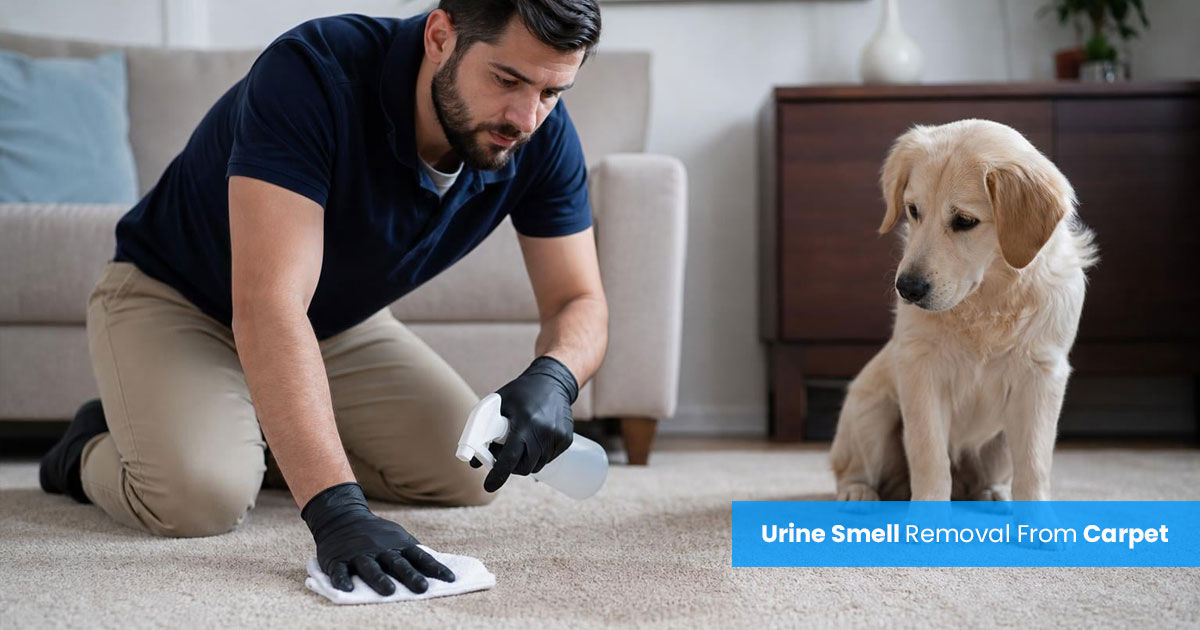
Urine Smell Removal From Carpet: Expert Guide (2026)
TL;DR
Urine smell removal from carpet means treating and extracting urine residues from every layer they have reached, not just masking the odour on the surface. Fresh accidents in the carpet face can often be handled with blotting, enzymatic cleaners, and thorough drying. But if the urine has soaked into the backing, underlay, or subfloor, surface cleaning will not solve the problem permanently. Humidity, rain, and even well-intentioned shampooing can reactivate old urine residues, making the smell worse than before.
What Is Urine Smell Removal from Carpet?
Urine smell removal from carpet is the process of locating urine contamination, breaking down odour-causing residues (urea, bacteria, ammonia compounds, and uric salts), extracting as much contamination as possible, and drying the carpet thoroughly so the odour does not return.
That definition matters because most people treat the problem like it is a surface stain. Spray something on top, wait, vacuum, done. But urine is not paint sitting on top of the carpet. It is a liquid that travels downward and outward the moment it hits the fibres.
According to the Carpet and Rug Institute, pet urine can weaken carpet layers, cause backing separation, damage seams, and create odour problems that return in high humidity if the urine is not completely removed. source Australian carpet cleaning practitioners describe the same thing: what looks like a small surface spot can spread into carpet backing, underlay, and the floor beneath. source
This is not a niche problem. Around 73% of Australian households own a pet, with the national pet population estimated at 31.6 million. source Add in toilet training toddlers, elderly incontinence, and inherited rental carpets, and urine odour in carpet is one of the most common household cleaning problems in the country.
The distinction between odour masking and actual urine smell removal from carpet is the core idea behind everything that follows.
Why Urine Smell Stays in Carpet
Understanding why the smell persists will save you from wasting time and money on the wrong approach.
When fresh urine hits carpet, most of the liquid is water. It soaks through the pile fibres, through the carpet backing, and (depending on volume and frequency) into the underlay and sometimes the subfloor beneath. As the water evaporates, it leaves behind a cocktail of urea, uric acid, bacteria, proteins, and salts.
Here is where things get frustrating. Those dried residues, particularly the uric salts and crystals, do not just sit there quietly. The National Carpet Cleaners Association explains that dried urine crystallises, that these crystals produce odour when they come into contact with moisture, and that humid days or cleaning can make the smell return. source
For anyone living in South East Queensland, from the Gold Coast through to Brisbane and Logan, this is not an edge case. Humidity is a daily reality for much of the year. Old urine residues buried in carpet backing or underlay can become noticeably smelly after rain, during summer, or anytime indoor moisture levels rise.
There is also a behavioural loop. PetMD notes that dog urine contains pheromones that can encourage repeat urination in the same spot. source So if the smell is still detectable to a dog or cat (even if you cannot smell it yourself), the pet may keep returning to the same area. Each accident pushes contamination deeper.
The short version: urine smell lingers because the residues are still physically present in the carpet layers, and moisture reactivates them. Spraying fragrance on top does nothing to change that.
Fresh Urine vs Old Urine: Why the Method Changes
This is a gap in most advice articles. They list a dozen cleaning methods without first asking: how old is this urine, and how deep has it gone?
Fresh Urine (Minutes to Hours Old)
Fresh accidents are the easiest to treat because the urine may still be mostly in the carpet face fibres. Speed matters.
- Blot, do not rub. Use white towels or paper towels. Press firmly to draw liquid upward. Scrubbing pushes urine deeper into backing and can damage fibres. Bissell specifically warns that scrubbing can spread urine and force it into carpet backing. source
- Keep blotting. Stand on the towels if you need to. Replace with fresh towels until no more moisture transfers.
- Rinse lightly with cool water if the carpet allows it. Avoid hot water at this stage.
- Extract liquid with a wet/dry vacuum if you have one. The IICRC recommends a wet/dry vacuum for liquid spills including pet urine. source
- Apply enzymatic urine cleaner according to the product label.
- Dry quickly. Use fans, open windows, or air conditioning.
Old Urine (Days, Weeks, Months, or Inherited)
Old urine is a different problem entirely. The liquid is gone, but the residues are embedded.
- Locate the spots. Use your nose, close inspection, or a UV/black light in a darkened room. Humane World and PetMD both recommend UV tools to find hidden old urine spots. source
- Expect the affected area to be larger below the surface. Bissell recommends cleaning the visible spot plus at least two inches around it because urine spreads laterally beneath the pile. source
- Use enzyme cleaner with proper dwell time. This is not a quick spray and wipe (more on that below).
- Repeat if needed.
- If smell persists after the carpet dries, suspect the underlay or subfloor. Surface treatment cannot reach contamination that has moved below the carpet.
Best Ways to Remove Urine Smell from Carpet
1. Blot and Extract Liquid First
This is always step one. Removing as much physical urine (or rinse water) as possible before applying any product gives the treatment a better chance of working. A wet/dry vacuum is ideal. If you do not have one, layers of towels pressed down firmly work as a reasonable substitute.
Do not skip straight to deodoriser. Every millilitre of urine you remove mechanically is a millilitre that does not need to be broken down chemically.
2. Use an Enzymatic Urine Cleaner
For urine smell removal from carpet, enzymatic cleaners are the most reliable DIY product category. They contain enzymes designed to break down organic urine residues rather than simply covering the smell.
But here is where most people go wrong: a light mist sprayed across the carpet surface will not work if the urine soaked deep into the pile. The enzyme cleaner must reach the same depth as the urine. This means saturating the area, not just dampening it.
For heavily soiled spots, Bissell recommends applying enzymatic cleaner generously and covering it with a damp cloth for 12 to 24 hours to allow the enzymes time to break down the odour-causing particles. source
Practitioners on Reddit reinforce this constantly. In Houzz and carpet cleaning forums, users describe needing to soak or douse affected areas, allow proper drying time, and sometimes treat the underside of carpet or the underlay when contamination has gone deeper. source
3. Rinse and Extract Residue
After the enzyme treatment has had time to work and the area has dried, rinse and extract if you can. This step matters more than most articles acknowledge.
The IICRC warns that many consumer spot removers leave sticky or dirt-attracting residues, and that products claiming “no rinsing needed” should be viewed with caution. source Practitioners on Reddit describe this exact problem: repeated treatments with multiple products leave sticky, soapy residue that becomes a second issue on top of the original urine contamination. One r/CarpetCleaning thread detailed cleaner residue that kept foaming during wet-vac passes, compounding the problem with every new product applied.
If you have already used several different cleaners and the smell is still there, stop layering products. Focus on extraction and rinsing, or call a professional.
4. Dry the Carpet Quickly and Fully
Drying is not the afterthought. It is a critical part of urine smell removal from carpet.
The EPA advises keeping indoor humidity below 60% and drying wet materials within 24 to 48 hours to reduce mould risk. source Queensland Government guidance similarly warns that mould grows in damp, poorly ventilated spaces, with carpet specifically noted as a risk. source
Use fans, cross-ventilation, air conditioning, or a dehumidifier. Avoid over-wetting the carpet in the first place, and never leave a treated area to “dry on its own” in a closed, humid room.
Do Vinegar, Baking Soda, and Hydrogen Peroxide Work?
These three come up in every urine smell article. Here is what they actually do, and where they fall short.
Baking Soda
Baking soda is a reasonable odour absorber. Sprinkle a thin layer over a treated, still-damp spot, let it sit overnight, and vacuum thoroughly the next day. The AKC recommends this for residual odour on damp dog urine spots. source
It cannot, however, treat urine that has soaked into underlay. Think of it as a surface finishing step, not a deep treatment.
Vinegar
Vinegar is common DIY advice and can help reduce light, fresh odour. Several industry sources, including the NCCA, include diluted vinegar as an option for surface treatment. source
But there is a catch. Humane World warns against strong-smelling chemicals like ammonia or vinegar because the scent may encourage pets to reinforce a urine mark. source If the urine problem involves a dog or cat that keeps returning to the same spot, vinegar may work against you. For pet urine, enzymatic cleaners are a better choice.
Hydrogen Peroxide
Hydrogen peroxide can help lift some urine staining but carries real colour-loss risk. The IICRC warns that peroxide and “oxy” products can cause colour change or bleaching, and that 3% hydrogen peroxide is not recommended for wool or natural fibres without extensive testing. source
Always patch test hydrogen peroxide in a hidden area of carpet. If the colour changes, stop.
Can Steam Cleaning Remove Urine Smell?
This is one of the most confusing areas online. Some articles recommend steam cleaning for urine. Others say it makes things worse. Both can be right, depending on the context.
The problem with DIY steam or hot water on untreated urine: Heat and moisture can reactivate dried urine crystals and may bond urine proteins into carpet fibres, setting the stain and odour. Humane World warns against using steam cleaners on urine because heat can permanently set urine stain and odour into man-made fibres. source The AKC gives the same warning for dried dog urine. source
Professional hot water extraction is different. When a professional carpet cleaner pre-treats the urine area, then uses truck-mounted extraction equipment to flush and remove contamination, the process is not the same as running a retail steamer over an untreated spot. The extraction power of professional carpet steam cleaning equipment pulls moisture and residue out of the carpet, rather than just pushing hot water through and hoping for the best.
The rule: do not use heat as your first move on a urine spot. If you want to steam clean a carpet with suspected urine contamination, treat the urine first, or have a professional handle both steps.
Why Does Carpet Smell Worse After Shampooing?
This is one of the most common complaints in cleaning forums, and it catches people off guard.
Practitioners on Reddit describe this as “ghosts of urine past,” where carpet shampooing makes a previously tolerable smell suddenly overwhelming. One r/CleaningTips thread framed it as old urine salts being reactivated by the moisture from cleaning. source
Several things happen at once:
- Moisture reactivates dried urine crystals in the backing or underlay, releasing odour. The NCCA confirms this mechanism. source
- Shampoo can spread urine residue rather than extract it, especially if the machine is not extracting aggressively enough.
- Home carpet cleaning machines often lack the extraction power to pull contamination from the underlay. In r/CarpetCleaning, users and commenters repeatedly note that small home machines can clean the visible carpet face but leave urine behind in deeper layers. source
- Residue from the shampoo itself can remain in the carpet, attracting dirt and creating its own musty smell.
If the smell got worse after you cleaned the carpet, the urine is probably deeper than the surface. More shampooing will not fix it. At this point, enzymatic treatment with proper dwell time or professional extraction is the better path.
Cat Urine vs Dog Urine
Cat urine is widely considered the hardest case by both professionals and homeowners. The Carpet and Rug Institute specifically notes that complete cat urine odour removal is unlikely unless the cat urine can be completely removed from the carpet. source
Cat urine tends to be more concentrated than dog urine, and cats sometimes urinate in hidden spots repeatedly before anyone notices. By the time the smell is obvious, the contamination may have reached the underlay or subfloor.
Carpet cleaning communities on Reddit treat cat urine as a separate tier of difficulty. Multiple threads in r/CarpetCleaning describe cat urine cases where the only real solution was removing the carpet, replacing the underlay, and sealing or replacing the subfloor. source
Dog urine is not trivial, but fresh dog accidents tend to be more visible and easier to catch early. Repeated accidents from either species push the problem into a different category entirely.
When Is Professional Carpet Cleaning Needed?
Not every urine spot needs a professional. But some situations are unlikely to be resolved by DIY treatment alone.
|
Situation |
DIY Likely Enough? |
Why |
|---|---|---|
|
One fresh accident, treated immediately |
Usually yes |
Urine may still be in face fibres only |
|
Small fresh dog urine spot |
Often yes |
Blotting, enzyme cleaner, and extraction may work |
|
Old smell with no visible stain |
Often not |
Hidden urine may be in backing or underlay |
|
Smell worse after shampooing |
Often not |
Moisture reactivated deeper residues |
|
Repeated accidents in the same spot |
Often not |
Underlay is likely contaminated |
|
Cat urine, especially old or repeated |
Often not |
Concentrated, deep, and hard to fully extract |
|
End-of-lease inspection deadline |
Professional recommended |
Risk of odour returning after DIY drying |
|
Dark staining visible under carpet or pad |
No |
Subfloor remediation likely needed |
A professional carpet cleaner may inspect the affected area, identify whether the odour is in the carpet face, backing, underlay, or subfloor, apply suitable pre-treatment, extract contamination with truck-mounted equipment, and advise on whether underlay replacement or subfloor treatment is needed.
Australian cleaning practitioners describe professional processes that can include mapping contamination, injecting treatment into affected layers, hot water extraction, underlay replacement, subfloor sealing, and carpet backing treatment for severe cases. source
If you are dealing with an end-of-lease situation where urine odour needs to be resolved before an inspection, it is worth getting professional help early rather than discovering the smell has returned the day before handover. End-of-lease carpet cleaning is a common service request for exactly this reason.
Can the Carpet Be Saved?
Sometimes the honest answer is no. Here is a practical framework.
|
Layer Affected |
Signs |
Likely Fix |
|---|---|---|
|
Carpet face fibre only |
Fresh accident, small area, no recurring smell |
Blot, enzyme cleaner, extract, dry |
|
Backing and underlay |
Smell returns after drying, spot feels larger than visible stain, repeated accidents |
Enzyme saturation, extraction, professional inspection, possible underlay treatment or replacement |
|
Subfloor (concrete or timber) |
Smell persists after carpet cleaning, dark stains visible under pad, strong ammonia smell, previous tenants with pets |
Lift carpet, replace underlay, treat or seal subfloor, professional remediation |
Cleaning industry publications argue that cleaning companies should set realistic expectations: complete pet urine odour removal may not be possible without replacing carpet and underlay and sealing or replacing the subfloor. This is not a failure of the cleaning method. It is the reality of a liquid that has physically soaked into porous materials.
For less severe situations, professional carpet cleaning with proper pre-treatment and truck-mounted extraction can make a significant difference. For catastrophic contamination, replacement may be the only real fix.
What Not to Do
These mistakes come up repeatedly in practitioner discussions and industry guidance.
Do not scrub. Scrubbing spreads urine laterally, pushes it deeper, and damages carpet fibres.
Do not use ammonia-based cleaners. Urine breaks down into ammonia compounds. Adding more ammonia-scented cleaner can encourage pets to re-mark the same spot. source
Do not use heat or steam as your first step. Heat on untreated urine can set stain and odour permanently.
Do not keep layering scented products. If you have already tried three different cleaners and the smell is still there, adding a fourth is unlikely to help. Focus on extraction, not more product.
Do not rely on an air purifier to fix carpet contamination. The EPA notes that air cleaners are adjuncts, not single solutions, and source control is still necessary. source A carbon-filter purifier may reduce airborne odour while you address the carpet, but it will not remove urine from the fibres.
Do not use ozone generators. The EPA warns that ozone can be harmful and that ozone concentrations would need to greatly exceed health standards to effectively remove many indoor air contaminants. source This is not a safe or effective DIY approach.
How to Prevent Urine Smell from Coming Back
Once you have treated the odour, a few steps help keep it from returning.
Remove the source completely. Partial treatment is the main reason smell comes back. If the smell returns after rain or humid weather, the source is probably still in the carpet layers.
Dry thoroughly after any treatment. In warm, humid homes across the Gold Coast, Brisbane, and Logan, quick drying is not just about comfort. Slow drying lets moisture linger in underlay, reactivating residues and increasing mould risk.
Remove scent traces for pets. If a dog or cat can still detect urine in a spot, they may continue using it. Enzymatic cleaners help because they break down the organic compounds pets can smell, not just the ones humans notice.
Check pet health if accidents start suddenly. PetMD advises a vet check when a housetrained dog starts having accidents, because the cause could be a medical issue rather than a behavioural one. source Cleaning the carpet without addressing the cause means more accidents ahead.
Consider regular professional maintenance. Periodic professional carpet cleaning helps address embedded residues before they build up, especially in homes with pets or young children.
If urine accidents also affect sofas, armchairs, or car seats, the same principles of blotting, enzyme treatment, and extraction apply. Upholstery cleaning follows a similar process, though fabric types and construction require different handling than carpet.
Glossary of Related Terms
|
Term |
What It Means |
|---|---|
|
Enzymatic cleaner |
A cleaner containing enzymes that break down organic urine residues rather than masking smell |
|
Uric salts / urine crystals |
Dried urine residues that reactivate and produce odour when they come into contact with moisture |
|
Carpet backing |
The layer beneath the visible carpet pile where urine can pool after surface cleaning |
|
Underlay / padding |
The cushion layer between carpet and subfloor, which acts like a sponge for liquids |
|
Subfloor |
The timber or concrete floor beneath the underlay, which may need sealing or replacement in severe contamination |
|
Wicking |
The process where stain or odour rises back up through carpet fibres as the carpet dries |
|
Hot water extraction |
A professional cleaning method that uses heated water and suction to flush and remove contamination |
|
UV / black light |
A tool used to locate dried urine spots that are not visible under normal lighting |
|
Odour masking |
Covering a smell with fragrance without removing the source, which is not the same as urine smell removal |
|
Patch test |
Testing a cleaning product in a hidden area of carpet before applying it to the visible spot |
Need Help with Stubborn Carpet Odour?
If the smell comes back after DIY cleaning, gets worse after shampooing, or you suspect the underlay is affected, it is worth getting a professional assessment before the odour spreads or worsens in humid weather.
Joni’s Cleaning provides professional carpet steam cleaning across the Gold Coast, Logan, Brisbane, and Tweed Heads using truck-mounted equipment for deeper extraction. Transparent quotes with no hidden fees. Get in touch for a quote and find out whether your carpet can be saved.
Frequently Asked Questions
What is the best way to remove urine smell from carpet?
Blot or extract as much urine as possible first. Then apply an enzymatic urine cleaner with enough product to reach the same depth the urine reached. Allow proper dwell time (up to 12 to 24 hours for heavy contamination, per Bissell’s guidance). Rinse and extract residue if you can, then dry the carpet quickly and thoroughly. For old or repeated odour, professional cleaning or underlay replacement may be needed.
Why does my carpet smell like pee after cleaning?
Cleaning adds moisture to the carpet. That moisture can reactivate dried urine crystals and salts that are trapped in the backing or underlay, making the smell suddenly stronger. Shampoo may also spread urine residue rather than removing it, and home machines often cannot extract contamination from the deeper layers. source
Does vinegar remove urine smell from carpet?
Vinegar can reduce light, fresh urine odour on the carpet surface. It is not the most reliable treatment for dried pet urine, repeated accidents, or contamination that has reached the underlay. For pet urine specifically, strong vinegar odour may also encourage some animals to re-mark the same spot.
Can steam cleaning remove urine smell?
Not as a first step. DIY steam or hot water on untreated urine can set the odour by bonding urine proteins into fibres and reactivating urine crystals. Professional hot water extraction is different because it typically follows pre-treatment and uses truck-mounted equipment to flush and remove contamination rather than just wetting it.
Is cat urine harder to remove than dog urine?
Generally yes. Cat urine is more concentrated, and cats often urinate in hidden areas repeatedly before the problem is noticed. The Carpet and Rug Institute states that complete cat urine odour removal is unlikely unless the urine can be completely removed from the carpet. source Old, repeated cat urine often requires professional treatment or carpet and underlay replacement.
How do I find old urine spots in carpet?
Use a UV or black light in a darkened room. Urine residues often fluoresce under UV light, making hidden spots visible. Mark the areas and remember that the contamination below the carpet surface is usually larger than what you see on top.
Will urine smell go away by itself?
Not reliably. Dried urine residues remain in the carpet layers, and humidity or moisture can reactivate the smell at any time. In humid climates like South East Queensland, old urine odours can become noticeable again during summer or after rain, even if the spot seemed fine for months.
When should I call a professional carpet cleaner for urine odour?
Call if the odour returns after DIY treatment, gets worse after shampooing, involves cat urine, covers a large area, has been there for a long time, or if you are preparing for an end-of-lease inspection and cannot risk the smell returning. Also call if you suspect the underlay or subfloor is contaminated, as surface treatment will not resolve those cases.