
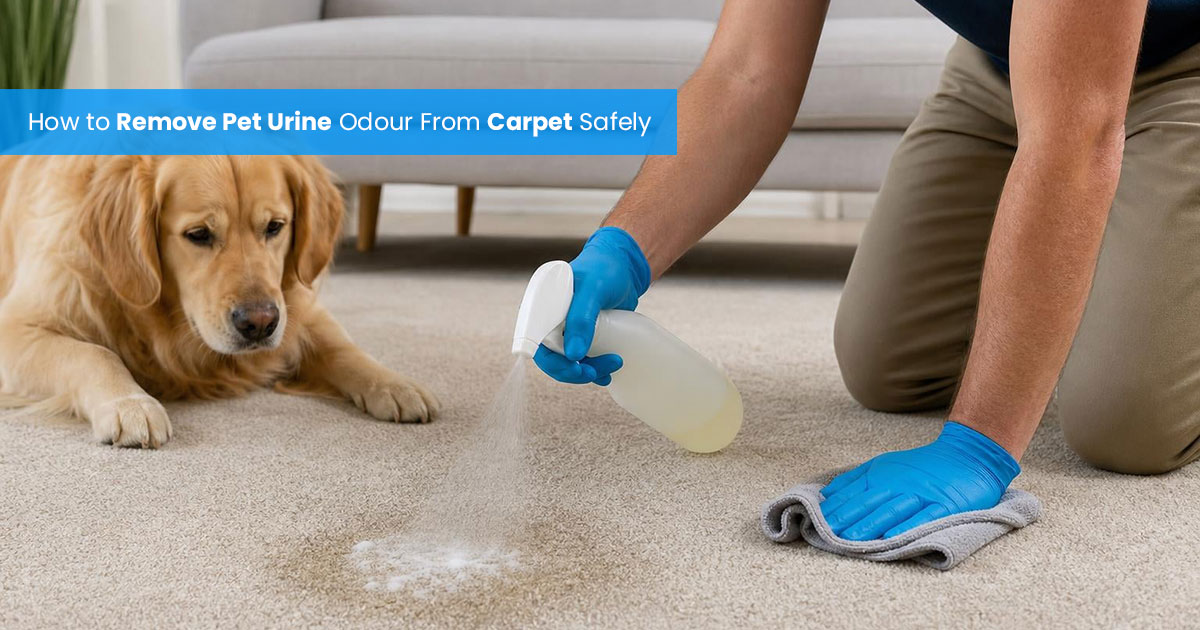
How to Remove Pet Urine Odour From Carpet Safely (2026)
TL;DR
Pet urine odour persists because uric acid crystals bond to carpet fibres and cannot be dissolved with water or standard cleaners. The only proven way to permanently remove pet urine odour from carpet safely is to use an enzymatic cleaner that breaks down these crystals at a molecular level. On the Gold Coast and across South East Queensland, high humidity constantly reactivates dormant urine residues, making proper treatment even more critical. This guide defines every term you need to understand the problem and choose the right solution.
Why This Glossary Exists
If you have cleaned a pet urine stain only to have the smell come back days later, you are not imagining things. The odour returns because the residues are still physically present in your carpet, trapped in layers you cannot see. Standard cleaning removes what is on the surface. It does not touch what has soaked through to the backing, the underlay, or even the subfloor beneath.
This glossary covers every term, method, and safety concern involved in removing pet urine odour from carpet safely. It is written for pet owners on the Gold Coast, in Logan, Brisbane, and across South East Queensland, where subtropical humidity makes urine odour problems significantly worse than in drier climates. Whether you are attempting a DIY fix or deciding if you need professional carpet steam cleaning, understanding these terms will help you make the right call.
The Science: Why Pet Urine Odour Lingers
Before getting into definitions, it helps to understand the core problem. Pet urine is not just a surface stain. It is a multi-layered contamination event that changes chemically over time.
When a pet urinates on carpet, the warm liquid quickly penetrates through the fibres, into the carpet backing, and often into the padding and subfloor underneath. According to Bissell’s cleaning research, the liquid spreads beneath the surface to an area 5 to 10 times larger than the visible stain. This is sometimes called the “iceberg effect,” and it is the reason so many cleaning attempts fail. You treat the spot you can see, but the contamination zone is far larger.
As the urine dries, it forms uric acid crystals. These crystals are not water-soluble. They bond tightly to carpet fibres and remain viable for years in porous materials. When fresh, urine has an acidic pH of about 5 to 6. Once dried, that chemistry flips to highly alkaline, with a pH between 10 and 12. At this stage, the stain becomes much harder to remove, and permanent discolouration becomes a risk.
Here is the part that matters most for Gold Coast residents: on a humid day, or when the carpet gets slightly damp, those dormant crystals reactivate. The smell comes back as strong as ever. In South East Queensland, where humidity is a daily reality for much of the year, this cycle can repeat endlessly unless the crystals are destroyed at the molecular level.
Understanding how to remove pet urine odour from carpet safely starts with understanding this chemistry. Everything that follows builds on it.
Glossary of Key Terms: Understanding the Problem
Uric Acid Crystals
The primary reason pet urine odour persists after cleaning. Uric acid is a compound containing nitrogen, carbon, hydrogen, and oxygen that crystallises as urine dries. These crystals are not water-soluble, which means regular detergents, water, and most household cleaners cannot dissolve them. They bond to carpet fibres and stay put.
Why it matters: If your pet keeps returning to the same spot, they can still smell the uric acid even after you have cleaned the visible stain. Removing the odour completely is not just about freshness. It is about breaking the cycle of repeat accidents.
Humidity Reactivation
The process by which dormant urine residues release odour again when exposed to moisture or high humidity. Even a carpet that seems clean can start smelling on a humid afternoon because moisture in the air is enough to reactivate uric acid crystals.
Why it matters: This is the defining challenge for pet owners in subtropical climates. A cleaning method that works in a dry Phoenix home may not hold up through a Gold Coast summer. Any approach to removing pet urine odour from carpet safely needs to account for ongoing humidity exposure.
Wicking
A term professionals use to describe stains that appear to return after cleaning. Carpet fibres act like a candle wick, drawing contamination from deeper layers (backing, underlay) back up to the surface as the carpet dries. Practitioners on carpet cleaning forums frequently identify wicking as the reason customers think their carpet cleaner “didn’t work.”
Why it matters: If a stain reappears within hours or days of cleaning, the problem is not on the surface. The contamination runs deeper, and the solution needs to reach those deeper layers too. As one cleaning professional on Quora puts it, “the liquid has to go as deep into the carpet as the urine did.”
Pheromone Marking and the Re-Soiling Loop
Dog urine contains pheromones that signal to the dog (and other animals) that this is an acceptable spot to urinate. If any trace of urine remains, even traces undetectable to the human nose, pets will return to that location. This creates a feedback loop: the pet urinates, you clean the surface, some residue remains, and the pet urinates there again.
Why it matters: Odour removal is not just a cleaning problem. It is a behaviour problem. Breaking the re-soiling loop requires complete elimination of the odour source, not just masking it. For more on addressing this cycle, see our urine smell removal guide.
Delamination
Structural damage to carpet caused by prolonged moisture exposure. Pet urine can weaken the adhesive bond between the carpet’s face fibres and its backing layers. According to the Carpet and Rug Institute, repeated pet accidents that soak through carpet can compromise the backing, causing layers to separate. Once delamination occurs, the carpet may need replacement.
Why it matters: This is the point where cleaning, no matter how thorough, cannot fix the problem. Delamination is a structural failure, not a stain.
Glossary of Key Terms: Detection
UV Blacklight Detection
A UV blacklight causes phosphorous and proteins in dried urine to glow yellow-green, making old stains visible that are otherwise invisible to the naked eye. For best results, use a light in the 365nm wavelength range, which penetrates surfaces more deeply and produces less visible purple light, giving more accurate results.
Why it matters: You cannot treat what you cannot find. Many pet owners are shocked to discover, under UV light, that urine contamination extends far beyond the spots they knew about. Before attempting to remove pet urine odour from carpet safely, a blacklight sweep of the room reveals the true scope of the problem.
Colourfast Test
A simple test performed in an inconspicuous area of the carpet before applying any cleaning solution. Apply a small amount of the product to a hidden spot (behind a door, inside a closet), wait the recommended time, then blot with a white cloth to check for colour transfer.
Why it matters: Hydrogen peroxide, certain enzymatic cleaners, and even vinegar can discolour certain carpet dyes. Running a colourfast test takes two minutes and can prevent permanent damage to an entire room of carpet.
Glossary of Key Terms: DIY Cleaning Methods
Blotting
The correct technique for absorbing fresh pet urine from carpet. Press plain white towels or paper towels firmly into the wet area to absorb as much liquid as possible. Never scrub. Scrubbing spreads the stain further into the carpet fibres and can damage the pile.
Why it matters: Blotting is the single most important first response to a fresh accident. The more urine you absorb before it penetrates the backing, the less contamination you need to deal with later. Every credible cleaning guide, from the Humane Society to professional forums, agrees on this point.
Enzymatic Cleaner
A cleaning product containing specific biological enzymes that break down the organic compounds in pet urine at a molecular level. This is the only type of cleaner proven to destroy uric acid crystals rather than simply masking them.
Three enzyme types matter here:
- Proteases break down protein-based stains, including those found in urine, feces, and other bodily fluids.
- Amylases tackle starch-based compounds sometimes present in the mix.
- Uricase specifically targets uric acid, breaking it down into carbon dioxide and ammonia, both of which evaporate harmlessly.
Enzymatic cleaners are biodegradable and generally considered safe for use around pets and children. They work by digesting organic material, which means they need adequate contact time to do their job (see Dwell Time below).
Why it matters: If you take away one thing from this entire glossary, it should be this: enzymatic cleaners are the only reliable way to permanently remove pet urine odour from carpet safely using a DIY method. Standard carpet shampoos, soap, and water will not break the chemical bonds holding uric acid crystals in place.
Enzymatic cleaners also work on upholstery and mattresses. If your pet has soiled other surfaces, the same principles apply. Our guide on urine smell removal from mattresses covers the specifics.
Vinegar and Baking Soda
A commonly recommended home remedy. The typical approach involves blotting the area, applying a solution of white vinegar and water, letting it dry, then sprinkling baking soda over the spot.
The honest assessment: vinegar may help with slight surface odour and can loosen some residues, but it does not break down uric acid crystals. Baking soda is a mild deodoriser that can temporarily reduce smell but cannot address the root cause. Multiple sources confirm these household products cannot cut down the ammonia crystals found in urine, meaning pets may continue marking the same area.
Critical warning: If you plan to use an enzymatic cleaner later, avoid soaking the area with vinegar first. The acidity can inhibit the enzymes and reduce their effectiveness. Also, never put vinegar in a carpet cleaning machine. The acid can corrode internal parts and leave a persistent sour smell.
Why it matters: Vinegar and baking soda are fine for small, fresh surface spills where the urine has not penetrated the backing. For anything beyond that, they create a false sense of “clean” while the real problem continues underneath.
Hydrogen Peroxide (3%)
A mild oxidising agent used for spot treatment of tough or discoloured urine stains. It is especially effective at removing the yellowish discolouration caused by dried urine, working by breaking down stain pigments. Its primary role is stain removal, not odour elimination.
Safety caveats: Check the concentration on the bottle. If it says more than 3%, you risk bleaching your carpet’s colour. Even at 3%, hydrogen peroxide can lighten darker carpet fibres. Always perform a colourfast test first. Never use hydrogen peroxide on wool, silk, or other natural fibre carpets.
Why it matters: Hydrogen peroxide can be a useful companion to enzymatic cleaners when dealing with visible yellow staining, but it should never be the sole treatment for odour.
Dwell Time
The amount of time a cleaning solution needs to remain in contact with the contaminated area to work effectively. For most enzymatic cleaners, this is 10 to 30 minutes for lightly soiled areas. For heavily soiled areas or old stains, many product labels recommend applying the formula and covering it with a damp cloth for 12 to 24 hours.
Why it matters: Rushing the process is a common reason DIY treatments fail. Enzyme cleaners work by slowly digesting organic material. Wiping them up after five minutes means the job is only partly done, and the odour will return.
Glossary of Key Terms: Professional Methods
Hot Water Extraction (Steam Cleaning)
A professional cleaning method that injects hot water and cleaning solution deep into carpet fibres, then extracts the dirty water with powerful suction. This is the method most commonly referred to as “steam cleaning,” though technically the water is heated, not converted to actual steam.
Key nuance that most guides miss: Steam cleaning alone does not remove pet odours permanently. Heat can set protein-based stains and temporarily intensify odours by reactivating uric acid crystals. Effective pet odour removal requires enzymatic pre-treatment before any heat-based cleaning method is applied. A professional who understands this will always pre-treat urine-affected areas before extraction.
Why it matters: If you have tried a rental machine and the smell got worse, this is likely why. The heat reactivated the crystals, and the machine lacked the suction power to extract them. Professional-grade equipment, particularly truck-mounted systems, provides far more extraction force than portable consumer machines.
Truck-Mounted Extraction
A professional carpet cleaning system where the equipment is mounted in a service vehicle rather than carried inside the home. The engine powers a high-pressure water heater and a vacuum system significantly more powerful than any portable unit. This means hotter water, stronger suction, and faster drying times.
Why it matters: Practitioners on Reddit’s carpet cleaning forums repeatedly identify pad and subfloor contamination as the point where DIY methods fail. One common warning: repeated wetting with a home Bissell or similar portable machine can actually reactivate dried urine salts, make the smell worse, and push contamination deeper. Truck-mounted systems extract at a level that portable machines simply cannot match.
Explore carpet cleaning services on the Gold Coast →
Carpet Underlay / Padding
The foam or fibre layer between your carpet and the subfloor. In cases of repeated accidents, older stains, or large-volume incidents, urine often soaks through the carpet backing and saturates the underlay. At this point, no amount of surface cleaning will eliminate the odour. The padding may need to be cut out and replaced. If urine has reached the subfloor, the exposed area may need to be treated with an enzymatic solution and sealed before new padding and carpet are installed.
Why it matters: Padding replacement is the most common professional recommendation when a UV blacklight reveals extensive contamination. The cost comparison is worth knowing: professional urine treatment typically runs a moderate charge per treatment session, while full carpet and underlay replacement can cost $300 to $500 per room.
Subfloor Treatment
When urine has penetrated through the carpet and padding to reach the concrete or timber subfloor, the subfloor itself must be treated. This typically involves enzymatic application directly to the floor surface, followed by sealing with a stain-blocking primer. Without this step, odour will continue to migrate upward through any new padding and carpet installed above.
Cat Urine vs. Dog Urine: Key Differences
Not all pet urine is the same. Cat urine contains significantly higher concentrations of ammonia than dog urine. If not cleaned immediately and thoroughly, the water evaporates and leaves behind an even more concentrated ammonia residue. This is why cat urine odour is often described as overwhelming compared to dog urine.
The contamination patterns differ too. Cats tend to urinate near walls and corners. Experienced carpet cleaners report that 99% of the time, cat urine contamination will be found within 3 feet of walls. Dogs, on the other hand, go randomly throughout a room, making detection more of a whole-floor exercise.
Spaying or neutering can reduce the intensity of urine odour, particularly in male cats, whose urine contains additional compounds when they are intact. Regardless of the source, the approach to removing pet urine odour from carpet safely remains the same: enzymatic treatment is the only method that addresses the underlying chemistry.
For a deeper look at the specific challenges of feline accidents, see our cat urine smell removal guide.
Safety Terms: What “Safely” Actually Means
The word “safely” in how to remove pet urine odour from carpet safely is not just about protecting the carpet. It is about protecting the people and animals living in the home. Most guides mention “test in an inconspicuous area” and move on. The reality is more complex than that.
Pet-Safe Cleaning
A product or method that does not contain ingredients harmful to pets during or after application. Enzymatic cleaners are generally considered pet-safe because they use biological compounds that break down into harmless byproducts. However, “pet-safe” is not a regulated label. Always read ingredient lists and keep pets off treated areas while the carpet is wet.
Ammonia-Based Products: Why to Avoid Them
Ammonia smells like urine to pets. Using an ammonia-based cleaner on a urine stain can actually encourage your pet to re-soil that spot. Beyond the behaviour problem, ammonia is a respiratory irritant for both humans and animals.
Never mix household ammonia with bleach. This combination produces a toxic gas called chloramine, which can cause shortness of breath and chest pain. This warning applies to any scenario where cleaning products are combined, not just urine treatment.
Essential Oil Toxicity
Some guides recommend adding essential oils like eucalyptus or tea tree oil to DIY cleaning solutions for fragrance. This is risky around pets, especially cats. Cats lack certain liver enzymes needed to metabolise the phenols in many essential oils. Exposure to undiluted essential oils, or even diffused oils in high concentration, can cause toxicity symptoms including drooling, vomiting, tremors, and respiratory distress.
Hydrogen Peroxide Concentration Limits
Household hydrogen peroxide at 3% concentration is generally safe for spot treatment on light-coloured, colourfast carpets. Higher concentrations (available at beauty supply stores and pool supply shops) can cause rapid, irreversible bleaching. If the label says anything higher than 3%, do not use it on carpet.
Heat and Protein-Based Stains
Applying heat to a protein-based stain (which urine is) can set the stain permanently, similar to how heat sets an egg stain on fabric. This is why you should never use a steam cleaner on urine-affected carpet without enzymatic pre-treatment. It is also why hot water from the tap should be avoided during initial DIY blotting and treatment.
Protecting Carpet Fibre Types
Wool, silk, and other natural fibre carpets require special care. Avoid hydrogen peroxide, ammonia-based products, and high-pH cleaners on these materials. Even some enzymatic cleaners may not be suitable. When in doubt, contact a professional who has experience with delicate carpet types.
Health Risks of Untreated Pet Urine in Carpet
This is an angle most cleaning guides skip entirely, but it matters. Repeated pet stains that soak through carpet and saturate the padding attract moisture over time. In humid environments like the Gold Coast, this creates conditions for mould growth. Black mould can cause respiratory symptoms including coughing, wheezing, and nasal congestion. Aspergillus, another mould type that thrives in damp organic material, can lead to chronic lung conditions with prolonged exposure.
Ammonia off-gassing from concentrated dried urine is another concern. In poorly ventilated rooms with heavy contamination, ammonia levels can reach concentrations that irritate the eyes, throat, and lungs. This is especially concerning in nurseries, children’s rooms, and homes where someone has asthma or other respiratory conditions.
Removing pet urine odour from carpet safely is not just about comfort. It is a genuine health concern when contamination has built up over time.
When DIY Is Enough vs. When You Need a Professional
DIY can work when:
- The accident just happened (within the last hour)
- It is a single, isolated incident
- The urine has not penetrated beyond the surface fibres
- You have an enzymatic cleaner on hand and can apply it with proper dwell time
- A UV blacklight shows the contamination area is small and contained
Professional help is needed when:
- The smell returns after cleaning, especially on humid days
- You have found multiple stains under UV blacklight
- The carpet feels stiff, crunchy, or discoloured in the affected area
- Your pet continues returning to the same spots despite cleaning
- You are dealing with cat urine that has been present for more than a few days
- The padding feels damp or the subfloor is affected
- You are preparing for a bond inspection and cannot risk the smell returning (our end of lease carpet cleaning page covers this scenario)
The gap between DIY and professional results comes down to equipment and depth of treatment. A truck-mounted extraction system reaches contamination layers that no handheld machine can access. When selecting a professional, look for a service that pre-treats with enzymatic solutions before extraction. For guidance on evaluating providers, see our deep carpet cleaning company guide.
Quick-Reference: Safe Removal Steps
For a fresh pet urine accident, follow these steps in order:
- Blot immediately with plain white towels. Press firmly, do not scrub. Replace towels as they become saturated.
- Perform a colourfast test with your chosen cleaner in a hidden area.
- Apply an enzymatic cleaner generously. The treated area should be at least twice the size of the visible stain to account for sub-surface spread.
- Allow proper dwell time. Minimum 15 minutes for fresh stains, 12 to 24 hours for old or heavy contamination. Cover with a damp cloth to keep the area moist.
- Never use ammonia-based products. They smell like urine to pets and encourage re-soiling.
- Ventilate the room and allow the carpet to dry completely. Use fans or open windows.
- Keep pets and children off the treated area until it is fully dry.
- Verify with a UV blacklight after the area has dried to confirm no residue remains.
- If the odour returns, particularly on humid days, the contamination has reached deeper layers. Contact a professional.
Frequently Asked Questions
Does vinegar and baking soda actually remove pet urine smell from carpet?
Vinegar and baking soda can reduce surface odour temporarily, but they do not break down uric acid crystals, which are the source of persistent pet urine smell. These household products cannot dissolve the ammonia compounds in urine, so pets may continue to detect the spot and re-soil it. For permanent results, an enzymatic cleaner is necessary.
Why does my carpet smell worse after steam cleaning a pet urine stain?
Heat can reactivate uric acid crystals and set protein-based stains. If urine-affected carpet is steam cleaned without enzymatic pre-treatment, the hot water wakes up dormant odour compounds and can push contamination deeper into the padding. Always pre-treat with an enzymatic cleaner before applying any heat-based cleaning method.
Is hydrogen peroxide safe to use on carpet for pet urine?
Hydrogen peroxide at 3% concentration is generally safe for spot-treating visible yellow urine stains on light-coloured, colourfast carpets. However, it can bleach darker fibres, and it addresses staining rather than odour. Always perform a colourfast test first, and never use concentrations above 3%. Avoid using it on wool, silk, or other natural fibre carpets.
How do I find old, dried pet urine stains I can’t see?
Use a UV blacklight, ideally one with a 365nm wavelength, in a darkened room. Dried urine will glow yellow-green due to the phosphorous and proteins it contains. This is often the most eye-opening step in the process, as contamination is frequently much more widespread than expected.
Why does my carpet smell fine for a while and then the pet urine odour comes back?
This is humidity reactivation. Uric acid crystals lie dormant in dry conditions but release odour when exposed to moisture, whether from rain, humidity, or even mopping nearby. On the Gold Coast and across South East Queensland, this cycle can repeat throughout the warmer months unless the crystals are fully destroyed with enzymatic treatment.
Can I remove pet urine odour from carpet safely without replacing the carpet?
Yes, in most cases. If the contamination is limited to the carpet fibres and has not saturated the padding or subfloor, enzymatic cleaning followed by professional hot water extraction can resolve the problem. When contamination has reached the underlay or subfloor, the padding may need replacement, but the carpet itself can sometimes be saved if treated promptly.
Are enzymatic cleaners safe around pets and children?
Enzymatic cleaners are biodegradable and use biological compounds that break down into harmless byproducts (carbon dioxide and ammonia gas, which evaporate). They are generally considered safe for homes with pets and children. However, keep the treated area off-limits while the carpet is wet, and allow it to dry completely before normal use.
How much does professional pet urine treatment cost compared to carpet replacement?
Professional urine treatment is significantly less expensive than replacement. Full carpet and underlay replacement can run $300 to $500 per room, while professional enzymatic treatment and extraction costs a fraction of that amount. For homes on the Gold Coast dealing with recurring pet odour issues, professional treatment is often the most cost-effective path to a permanent solution.