
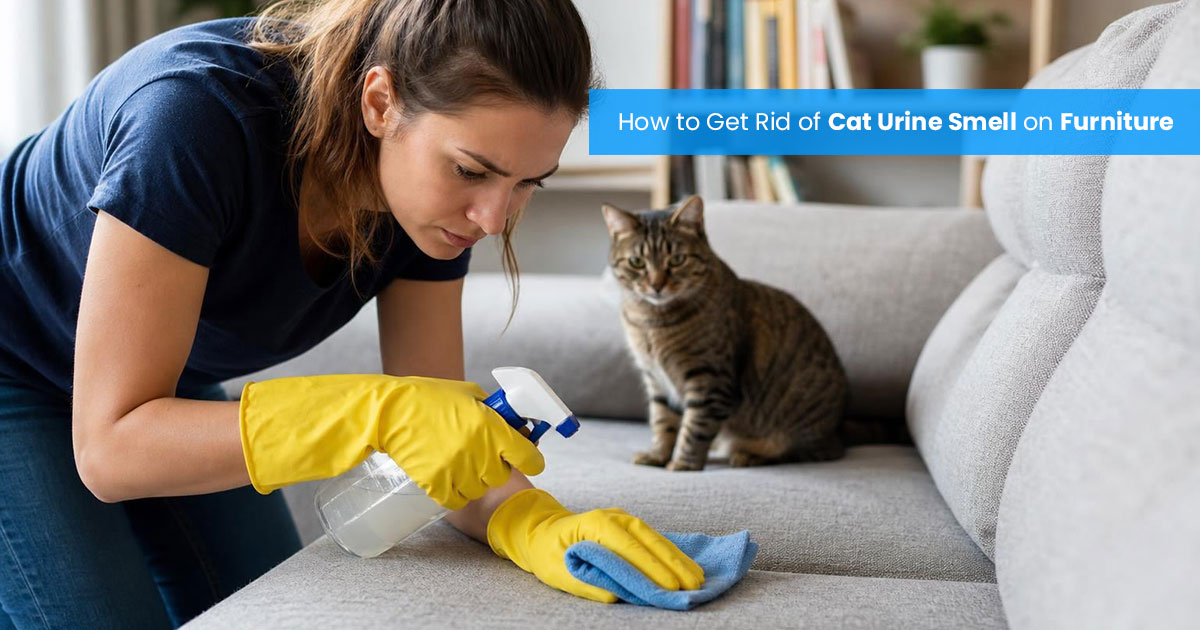
How to Get Rid of Cat Urine Smell on Furniture: 2026 Guide
TL;DR
Cat urine smell on furniture persists because of uric acid crystals that bind to fibres and recrystallise in humid conditions, making the odour return even after cleaning. Enzymatic cleaners are the gold standard for breaking down these crystals at a molecular level. DIY methods work for fresh, surface-level stains, but deep saturation into cushion foam usually requires professional hot water extraction. In subtropical climates like South East Queensland, the recrystallisation risk is significantly higher, making thorough treatment even more critical.
Why Cat Urine Smell on Furniture Is So Hard to Remove
If you’ve ever cleaned cat urine off a couch only to have the smell come roaring back a few days later, you’re not imagining things. The problem is chemical, not just cosmetic.
Cat urine contains a compound called uric acid that forms insoluble crystals when it dries. These crystals bind tightly to fabric fibres, foam padding, and wood frames. Unlike most organic stains, they don’t dissolve in water. They don’t respond to standard household cleaners. And here’s the part that frustrates people most: uric acid crystals are hydrophilic, meaning they absorb moisture from the air. When humidity rises, the crystals reactivate and release odour compounds all over again.
This is why a sofa that smelled fine last week can suddenly reek on a warm, humid day. For anyone living on the Gold Coast, in Brisbane, Logan, or anywhere in South East Queensland, this recrystallisation cycle is a year-round problem. Subtropical humidity means those uric acid crystals rarely stay dormant for long.
Understanding this chemistry is the first step toward actually fixing the problem, not just masking it. The sections below define every key term, compare every common method, and give you a clear framework for knowing when DIY will work and when it won’t.
If your furniture needs professional upholstery cleaning, that option is always available. But let’s start with the science.
The Chemistry of Cat Urine: Key Terms Defined
Getting rid of cat urine smell on furniture starts with understanding what you’re actually dealing with. Cat urine isn’t a single substance. It’s a cocktail of compounds, each one causing a different problem.
Urea
Urea is the sticky, water-soluble component of cat urine. It’s what makes the wet spot feel tacky. On its own, urea is relatively easy to clean up when fresh. The problem is what happens next: as urea breaks down, it converts into ammonia, producing that sharp, nose-burning smell that intensifies over time rather than fading.
Uric Acid
This is the real villain. Unlike urea, uric acid is not water-soluble. It forms microscite crystals that bind to whatever surface they land on, including upholstery fabric, the foam padding beneath, and even the wooden frame underneath. Standard soap and water cannot break these crystals apart. As one pet urine chemistry specialist noted, uric acid is “very notorious for reverting back to its comfort zone, the crystal/salt form,” which explains why cleaned spots keep smelling again.
Urochrome
Urochrome is the yellow pigment in urine. It’s responsible for the visible staining on light-coloured fabrics. While it’s not the main source of odour, urochrome stains act as a visual marker that can persist even after the smell is addressed, especially on cotton and linen upholstery.
Creatinine
A byproduct of muscle metabolism, creatinine contributes to surface discoloration. It’s not the primary odour culprit, but its presence adds to the overall persistence of urine stains and makes them harder to fully eliminate.
Mercaptans
As cat urine ages and bacteria decompose it, sulphur-based compounds called mercaptans develop. These are the same chemicals that give skunk spray its notorious smell. According to PetMD, this is why old cat urine stains smell dramatically worse than fresh ones. If your furniture has a skunky, rotten quality to the smell rather than just an ammonia sharpness, mercaptans have already formed.
Ammonia
Ammonia is the first-stage odour you notice as urea breaks down. It’s pungent and unmistakable. Here’s the critical warning: never clean cat urine with ammonia-based products. Dr. Bruce Kornreich of the Cornell Feline Health Center explains that because ammonia is a component of cat urine, cats that smell it on a surface are more likely to urinate there again. You’d be inviting a repeat performance.
Furniture Types: What You Need to Know
Not all furniture responds to cat urine the same way. The material determines how deeply urine penetrates, which cleaning methods are safe to use, and whether professional help is necessary.
Upholstery Care Labels (W, S, SW, X)
Before applying anything to your furniture, check the tag. Most upholstered furniture has a small label with a cleaning code:
- W means water-based cleaners are safe to use.
- S means solvent-only cleaning; water will stain or damage the fabric.
- SW means either water-based or solvent cleaners work.
- X means vacuum only, no liquid cleaners at all. Professional cleaning is your only option.
Look for these letters on the tag underneath the cushions or on the furniture’s underside. If you see “W” or “SW,” you can proceed with most of the DIY methods below. If you see “S” or “X,” skip straight to the professional help section.
Fabric Upholstery
Fabric sofas and armchairs are the most vulnerable to cat urine damage. The fabric absorbs the liquid quickly, and it wicks down into the foam padding and sometimes into the frame. A surface-level wipe won’t reach urine that has soaked into the interior. Even with a wet vacuum, it’s difficult to extract all the moisture from deep inside upholstery foam. If that liquid stays trapped, it won’t dry properly, creating a secondary problem: mould and mildew growth inside the cushion.
Microfibre
Good news if your cat chose the microfibre couch. Microfibre is made from densely packed microscopic filaments that resist liquid penetration better than traditional fabrics. Urine tends to sit on the surface longer, giving you more time to catch it. Blot thoroughly, apply enzymatic cleaner, and the prognosis is good.
Leather
Leather doesn’t absorb urine the way fabric does, which makes surface cleaning easier. A solution of one part vinegar to two parts water, sprayed on and wiped with a soft cloth, handles most fresh accidents. The catch: leather dries out after cleaning, so you’ll need to apply a leather conditioner afterward to prevent cracking. If urine has seeped into seams or stitching, enzymatic cleaner applied carefully with a cotton swab can reach those crevices.
Suede
Suede is the most delicate common upholstery material. Water can leave permanent marks. Blotting is your only safe DIY option. Do not rub, spray, or saturate. For suede furniture with cat urine, specialist professional cleaning is strongly recommended.
Sealed Wood
Wooden armrests, legs, or frames that have been sealed with polyurethane or lacquer can usually be cleaned with hydrogen peroxide applied to the surface. Unsealed or waxed wood is trickier because urine can soak into the grain. For set-in stains on unsealed wood, sanding and resealing may be necessary.
Methods Compared: How to Get Rid of Cat Urine Smell on Furniture
Blotting (The Correct First Step)
This deserves its own section because it’s where most people go wrong. When you discover fresh cat urine on furniture, blot the area with clean paper towels or a white cloth. Press down firmly, lift, and repeat with fresh material until no more moisture transfers.
Never scrub. Scrubbing pushes urine deeper into the fabric and spreads it outward, making the affected area larger and harder to treat. Practitioners on Reddit’s r/CleaningTips consistently emphasise this point: blotting makes a world of difference.
Vinegar and Water (1:1 Ratio)
White vinegar is mildly acidic and neutralises the alkaline salts that form in dried cat urine. Mix equal parts vinegar and cold water, apply to the stain, and blot. This works reasonably well for fresh, surface-level stains on hard surfaces or tightly woven fabrics. On porous upholstery where urine has soaked deeper, vinegar alone won’t reach the uric acid crystals embedded in the padding.
Baking Soda
Baking soda is an odour absorber, not a cleaner. Sprinkle it liberally over the affected area after your initial cleaning and leave it for anywhere from 15 minutes to overnight. Then vacuum it up. It works well as a companion step alongside vinegar or enzymatic treatment, but on its own, it won’t break down uric acid. Several sources recommend leaving baking soda for 8 to 12 hours for maximum absorption.
Hydrogen Peroxide and Dish Soap
This combination is a stronger oxidiser than vinegar. Mix four ounces of hydrogen peroxide with one teaspoon of dish soap. After blotting up as much urine as possible and covering the area with baking soda, pour the mixture over the spot and dab gently.
One important caution: hydrogen peroxide can discolour fabrics. Always test on a hidden area first. This method is best suited for white or light-coloured fabrics where minor bleaching isn’t a concern.
Cold Water, Not Hot
This is a detail many guides skip. When cleaning cat urine, always use cold water. Hot water activates the proteins in urine and can set the odour into the fabric permanently. Reddit cleaning communities repeat this tip frequently, and it’s backed by multiple veterinary sources.
Why Bleach Is Dangerous
Bleach does not break down uric acid. Worse, when bleach reacts with the ammonia in urine, it can release chloramine gas, which is harmful to both humans and pets. Keep bleach away from any urine-contaminated surface.
Enzymatic Cleaners: The Gold Standard
Enzymatic cleaners are the most effective product category for removing cat urine smell from furniture permanently. They work by using naturally occurring bacteria and enzymes to break down the organic compounds in urine, including proteins and uric acid, into smaller, odourless molecules.
How They Work
The enzymes in these products (protease, lipase, and amylase) each target different components. Protease breaks down proteins. Lipase handles fats. Amylase targets starches. A good enzymatic cleaner contains all three, giving it a broad spectrum capable of addressing the full complexity of cat urine.
The key advantage over DIY solutions: enzymatic action continues working as long as moisture is present. The enzymes keep digesting urine compounds that are absorbed deep within the fabric, far below where a surface spray can reach.
How to Apply Enzymatic Cleaner Properly
- Blot up as much urine as possible first.
- Saturate the stain thoroughly. Don’t just mist the surface. The cleaner needs to reach everywhere the urine went.
- Apply beyond the visible stain. If you have a stain that’s roughly one foot across, spread the cleaner in a two-foot circle. Urine wicks outward through fabric, and the affected area is always larger than what you can see.
- Let it sit. A minimum of 10 to 15 minutes is necessary, but overnight dwell time produces the best results, especially for older stains.
- Allow the area to air dry completely. Air drying is essential because the enzymatic process needs to finish its work. If you wipe the cleaner away too soon, uric acid will remain.
Products like Nature’s Miracle and Rocco & Roxie are the most frequently recommended enzymatic cleaners in online cleaning communities. Multiple Reddit users report needing three to five applications for old, set-in stains. That’s normal. Patience matters more than product selection.
UV Black Light: Finding Hidden Urine Spots
Sometimes you can smell cat urine but can’t locate it. A UV or black light solves this problem. In a darkened room (lights off, curtains closed), pass the black light slowly over your furniture. Urine deposits will fluoresce, appearing as bright yellow-green spots.
This is especially useful for finding old, dried stains that have no visible discolouration but are still releasing odour through uric acid recrystallisation. After cleaning, you can use the black light again to verify that treatment was thorough.
Old Stains vs. Fresh Stains: The Three-Day Threshold
Fresh cat urine (within the first 24 to 72 hours) is significantly easier to remove than old, dried stains. Once urine has been sitting for more than about three days, the uric acid has fully crystallised into its salt form. At this stage, water-based cleaning alone is essentially useless. The crystals are locked into the fabric.
For stains older than three days:
- Enzymatic cleaner is mandatory, not optional.
- Multiple applications are likely needed.
- If the urine has soaked through to the foam padding, even enzymatic cleaner applied from the surface may not penetrate deeply enough.
This is the point where learning how to get rid of cat urine smell on furniture shifts from a DIY project to one that may require professional equipment.
DIY Steam Cleaning vs. Professional Hot Water Extraction
This distinction confuses a lot of people, and getting it wrong can make the problem worse.
The Problem with DIY Steam Cleaners
Consumer-grade steam cleaners and carpet shampooers push water into upholstery but lack the suction power to extract it fully. When you steam clean a urine-soaked cushion with one of these machines, the heat and moisture can actually reactivate uric acid crystals and push them deeper into the padding. The result: the smell gets locked in rather than removed.
Professional Truck-Mounted Hot Water Extraction
Professional hot water extraction is a fundamentally different process. Truck-mounted equipment generates higher temperatures, higher water pressure, and far more powerful vacuum suction than any portable consumer unit. It flushes contaminants out of deep within the padding and extracts them, rather than just pushing them around.
This matters for cat urine specifically because the goal is to reach and remove uric acid crystals that have migrated below the surface fabric. If you’d like to understand how truck-mounted carpet cleaning equipment differs from portable units, the principles are the same for upholstery extraction.
The Two-Stage Protocol
The most effective approach for removing cat urine smell from furniture combines both methods in sequence:
- Stage one: Apply enzymatic cleaner generously to the affected area. Allow it to dwell overnight (or at minimum several hours). The enzymes break down uric acid crystals at the molecular level.
- Stage two: Follow up with professional hot water extraction. The truck-mounted equipment flushes out the broken-down compounds and any remaining residue from deep within the foam and fabric.
Rocco & Roxie, one of the top-selling enzyme cleaner brands, specifically recommends this approach. They advise against putting their product in a steam cleaner because heat deactivates the biological ingredients. Instead, they recommend pre-treating the area, letting it sit overnight, then having it steam cleaned a day or two later.
No ranking page on Google currently articulates this two-stage protocol clearly. It’s the most reliable method for permanent odour elimination.
Common Mistakes That Make Cat Urine Smell Worse
These errors are surprisingly common, and each one can turn a manageable problem into a persistent nightmare.
Scrubbing instead of blotting. Scrubbing forces urine deeper into fabric fibres and spreads it to a wider area. Always blot with downward pressure.
Using hot water. Heat activates proteins in urine and can permanently bond the odour to fibres. Use cold water exclusively until the enzymatic cleaner has done its work.
Using ammonia-based cleaners. Ammonia mimics a component of cat urine. Your cat may interpret the smell as a signal that this is an appropriate place to urinate again. You solve the smell temporarily but create a behavioural loop.
Not saturating a wide enough area. Urine spreads through fabric by capillary action. The wet area beneath the surface is always larger than the visible stain on top. Apply cleaner in a circle at least twice the diameter of the visible stain.
Skipping dwell time. Enzymatic cleaners need time to work. Wiping them up after a few minutes defeats the purpose. Leave them for a minimum of 10 to 15 minutes, and overnight for old stains.
Assuming DIY steam cleaning equals professional extraction. As discussed above, consumer machines lack the extraction power needed and can set stains rather than remove them.
When to Call a Professional
Not every cat urine incident on furniture requires professional cleaning. Here’s a clear decision framework:
DIY is likely sufficient when:
- You caught the accident within hours.
- The stain is on the surface only (hasn’t soaked through the fabric into foam).
- The furniture is microfibre, leather, or sealed wood.
- One or two applications of enzymatic cleaner eliminate the odour.
Professional extraction is recommended when:
- Urine has soaked through to the cushion foam or padding.
- The stain is more than three days old, meaning uric acid crystals have fully formed.
- You’ve tried DIY enzymatic treatment multiple times but the smell returns, especially on humid days.
- The upholstery tag shows “X” (vacuum only) or “S” (solvent only).
- Multiple areas of the furniture are affected.
Multiple users on Reddit’s r/CleaningTips report that even after professional cleaning, deep cat urine in cushion foam sometimes means the foam itself needs replacement. This is an honest reality worth acknowledging. When urine has saturated foam padding completely, no amount of surface cleaning, whether DIY or professional, can fully extract every molecule. In those cases, removing and replacing the foam insert while professionally cleaning the fabric cover is the most effective path forward.
For Gold Coast, Brisbane, Logan, and Tweed Heads residents, the subtropical humidity adds another layer. Uric acid recrystallisation happens faster and more frequently in South East Queensland’s year-round moisture. A stain that might stay dormant in a dry climate will keep reactivating here. This makes thorough initial treatment, ideally the enzyme-then-extract protocol, particularly important.
If your furniture needs expert upholstery treatment, getting a professional assessment can save you from the frustrating cycle of cleaning and re-smelling.
Why the Smell Matters More in Queensland
This is a point that no other guide on this topic addresses, and it’s directly relevant to anyone searching for how to get rid of cat urine smell on furniture in South East Queensland.
The Gold Coast, Brisbane, and Logan experience subtropical humidity year-round. Average relative humidity regularly sits above 60%, and during summer it frequently exceeds 75%. Uric acid crystals absorb this airborne moisture, recrystallise, and release odour compounds. A couch that smells clean on a dry winter day can suddenly stink in January’s humidity.
This means that cleaning approaches designed for drier climates, where uric acid crystals may stay dormant for months, are less effective here. The threshold for “good enough” cleaning is higher in Queensland. What passes for adequate in Melbourne or Adelaide may fail in Southport or Robina within weeks.
If you’re dealing with a recurring cat urine smell on furniture despite multiple cleaning attempts, the climate is likely reactivating crystals that weren’t fully removed. The two-stage enzyme-then-extraction protocol is specifically designed to address this.
Why Cats Urinate Outside the Litter Box
Fixing the smell is only half the battle. Understanding why it happened can prevent it from happening again.
Cats are creatures of routine. Changes in the household, a new pet, a new baby, renovated rooms, even rearranged furniture, can cause stress that manifests as inappropriate urination. Medical issues like urinary tract infections, kidney disease, or diabetes can also drive cats to urinate outside the litter box.
Diet and hydration matter too. Cats that drink less water produce more concentrated urine, which amplifies the ammonia component significantly. The resulting smell is harder to remove.
Most importantly for cleaning purposes: your cat’s nose is far more sensitive than yours. Even faint residual traces of urine that you can’t detect are enough for your cat to identify that spot as a familiar elimination site. This is why thorough, science-based cleaning is essential. If any uric acid crystals remain, your cat can smell them and may return to the same spot.
If your cat has also urinated on carpeted areas, the same chemistry applies. Our cat urine smell removal guide for carpet covers the carpet-specific steps in detail.
If the problem has reached your mattress, that’s a separate challenge with its own considerations. Our mattress urine odour guide walks through the specifics.
Prevention: Stopping Repeat Incidents
Once you’ve removed the cat urine smell from your furniture, these steps help prevent it from happening again:
- Clean thoroughly enough to remove scent markers. Use a UV black light to verify no traces remain. If your cat can still smell it, they’ll return to the spot.
- Address the underlying cause. If your cat has started urinating outside the litter box suddenly, a vet visit is warranted to rule out medical issues.
- Maintain litter box hygiene. Cats are fastidious. A dirty or insufficient number of litter boxes (the general rule is one per cat plus one extra) is a common trigger.
- Manage stress triggers. Feliway diffusers, consistent routines, and gradual introductions to household changes can reduce stress-related marking.
- Improve hydration. Wet food and water fountains encourage cats to drink more, producing less concentrated (and less pungent) urine.
- Protect furniture proactively. Waterproof mattress-style protectors on couch cushions, placed underneath removable covers, create a barrier that prevents urine from reaching the foam.
FAQ
How many times do I need to apply enzymatic cleaner to remove cat urine smell from furniture?
For fresh stains caught within a day or two, one thorough application with adequate dwell time (overnight is ideal) often does the job. For old stains where uric acid has fully crystallised, expect to need three to five applications. Each round breaks down more of the embedded crystals. Don’t be discouraged if the first application only reduces the smell rather than eliminating it.
Can I use a regular household steam cleaner on cat urine furniture stains?
It’s not recommended as a first step. Consumer steam cleaners push heat and moisture into the fabric but lack the extraction power to pull contaminants out of the padding. This can actually lock the odour in deeper. If you want to steam clean, pre-treat with enzymatic cleaner first and allow it to sit overnight, then steam clean a day or two later. Professional truck-mounted extraction is far more effective than portable units.
Why does my couch still smell like cat urine after I cleaned it?
The most likely reason is uric acid recrystallisation. Standard cleaners and even some DIY methods break up uric acid temporarily, but the crystals re-form when exposed to moisture or humidity. In South East Queensland’s subtropical climate, this cycle happens frequently. Enzymatic cleaners are the only product type that breaks uric acid down at a molecular level rather than just dispersing it.
Is vinegar enough to remove cat urine smell from a couch?
Vinegar works for fresh, surface-level stains by neutralising the alkaline salts in dried urine. For deeper stains that have soaked into cushion foam, or for any stain more than a few days old, vinegar alone is not sufficient. It doesn’t break down uric acid crystals. Use it as a first response, then follow up with enzymatic cleaner.
How do I find hidden cat urine spots on furniture?
Use a UV or black light in a completely darkened room. Turn off all lights and close curtains, then slowly pass the black light over every surface of the furniture. Urine deposits will glow yellow-green. This works on dried, invisible stains that are still producing odour through crystal reactivation.
Will professional cleaning definitely remove the smell?
Professional hot water extraction combined with enzymatic pre-treatment is the most effective method available. It works in the vast majority of cases. The exception is when urine has completely saturated the foam padding inside cushions. In those extreme cases, replacing the foam insert while professionally cleaning the outer fabric cover may be necessary.
Can cat urine damage furniture permanently?
Yes. Prolonged exposure can break down fabric fibres, cause permanent discolouration from urochrome, and, in the case of wooden frames, lead to warping or staining that sanding alone won’t fix. The longer urine sits untreated, the more damage accumulates. Speed matters.
How do I get rid of cat urine smell on leather furniture specifically?
Dealing with cat urine on furniture is frustrating, but the chemistry is on your side once you use the right approach. Enzymatic cleaners break down what standard cleaners can’t, and professional extraction reaches what surface treatment misses.
If you’re in the Gold Coast, Brisbane, Logan, or Tweed Heads area and need help with furniture that won’t stop smelling despite your best DIY efforts, contact Joni’s Cleaning for a transparent quote with no hidden fees.
Dealing with cat urine on furniture is frustrating, but the chemistry is on your side once you use the right approach. Enzymatic cleaners break down what standard cleaners can’t, and professional extraction reaches what surface treatment misses.
If you’re in the Gold Coast, Brisbane, Logan, or Tweed Heads area and need help with furniture that won’t stop smelling despite your best DIY efforts, contact Joni’s Cleaning for a transparent quote with no hidden fees.