
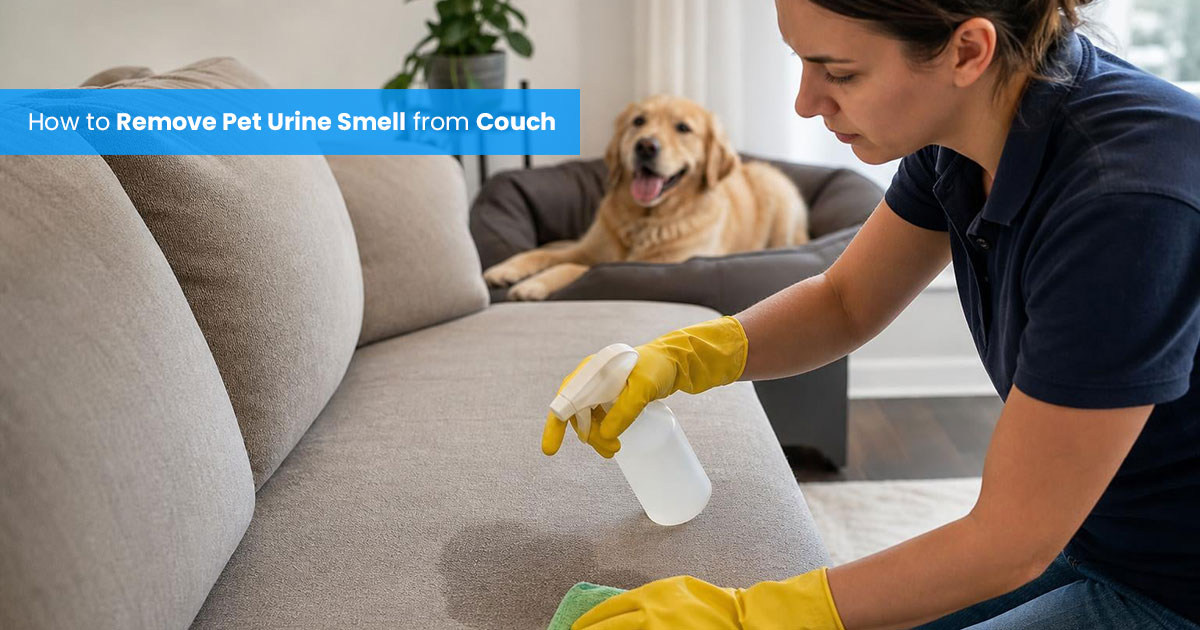
How to Remove Pet Urine Smell from Couch: 2026 Guide
TL;DR
Pet urine smell persists on couches because of uric acid crystals that don’t dissolve in water and reactivate in humid conditions. Enzymatic cleaners are the most effective DIY solution, but they must saturate the stain and dwell for 12 or more hours. Check your couch’s fabric cleaning code before applying any liquid. If the urine has soaked into foam padding, the stain is old, or you live in a humid climate like the Gold Coast, professional hot water extraction is usually necessary for permanent odour removal.
Why the Smell Keeps Coming Back (And What This Guide Will Help You Fix)
You’ve scrubbed the spot. The stain is gone. But every time you sit down, there it is again: that unmistakable pet urine smell baked into your couch. If this sounds familiar, you’re not alone, and you’re not doing anything wrong. The chemistry of urine is simply more stubborn than most cleaning products can handle.
This guide breaks down every term, method, and product you’ll encounter when figuring out how to remove pet urine smell from a couch. Instead of vague advice, you’ll get clear definitions, the science behind each approach, and honest guidance about when DIY works and when it doesn’t. If your pet has also had accidents on floors, our pet stain removal glossary covers carpet-specific terms.
For Gold Coast and Brisbane pet owners, humidity makes this problem noticeably worse. We’ll explain exactly why throughout this guide.
If you already know DIY won’t cut it, you can request an upholstery cleaning quote with no hidden fees.
The Problem: What’s Actually in Pet Urine
Understanding what you’re dealing with is the first step toward removing pet urine smell from your couch for good. Most people treat urine like any other liquid spill. It isn’t.
Uric Acid Crystals
This is the single most important term in this entire guide. Uric acid crystals are microscopic, salt-like deposits left behind after urine dries. Unlike other urine components, they are not water-soluble. Standard detergents, soap, and even vinegar cannot dissolve them. They embed themselves deep into porous surfaces like upholstery fabric, foam padding, and even wooden couch frames, where they can lie dormant for months or years.
Here’s what makes them especially frustrating: moisture reactivates them. On the Gold Coast, where subtropical humidity is a fact of life for much of the year, uric acid crystals release odour more frequently than they would in drier climates. This is why a couch can smell fine in winter and then become unbearable during a humid summer stretch. The same problem affects carpets, and we cover that in detail in our guide to removing pet urine odour from carpet.
Urea
Urea is the water-soluble component of urine responsible for the initial smell. It’s relatively easy to clean with soap and water, which is why your first wipe-down seems to work. But urea isn’t the long-term problem. Once it’s gone, the uric acid crystals remain behind, producing odour every time conditions are right.
Ammonia
Bacteria break down urea into ammonia, which is what gives aged urine that sharp, eye-watering smell. The longer urine sits untreated, the more ammonia builds up. Cat urine produces significantly more ammonia than dog urine due to dietary differences, which is why it tends to smell dramatically worse over time.
Felinine
Felinine is an amino acid found exclusively in cat urine. It breaks down into sulphur-containing compounds that produce that distinctly pungent odour cat owners know too well. Because cats are obligate carnivores, their protein-heavy diet means their urine contains more nitrogen than dog urine, which converts to more ammonia during decomposition. If you’re dealing specifically with cat urine, our cat urine smell removal guide goes deeper into the unique challenges involved.
Off-Gassing
Off-gassing describes the release of odour compounds from uric acid crystals when they’re exposed to moisture or warmth. It’s the reason the smell seems to come and go. A dry day might leave your couch smelling acceptable. A humid afternoon, or someone sitting on the cushion and generating body heat, can release a fresh wave of ammonia and other compounds. For Gold Coast households, off-gassing is a near-constant issue during the warmer months.
Detection: Finding Stains You Can’t See
Before you can remove pet urine smell from a couch, you need to find every contaminated area. Old stains often hide in places you’d never think to check.
UV Black Light
A UV black light is a handheld flashlight that emits ultraviolet light, causing proteins and phosphorus in dried urine to fluoresce yellow-green. The ideal wavelength is 365nm, which penetrates surfaces more effectively and produces less visible purple light, making stains easier to spot.
To use one: darken the room completely, then slowly pass the light over every surface of your couch, including the sides, back, and underside of cushions. You may be surprised by how far urine has spread beyond the visible stain.
One important limitation: UV black lights only detect dried urine. If the stain is still wet or damp, the glow will be weak or nonexistent. Wait until the area is fully dry before scanning.
Spot Test (Patch Test)
A spot test means applying a small amount of your chosen cleaning solution to a hidden area of the upholstery (like the underside of a cushion or the back of the couch near the bottom) and waiting 10 to 15 minutes to check for colour bleeding, water marks, or fabric damage. This step is essential before any treatment, especially on delicate or dark-coloured fabrics. Skip it, and you risk turning a urine stain into a bleach spot.
DIY Cleaning Methods and Products
These are the most commonly recommended approaches for removing pet urine smell from a couch at home. Each has strengths and limitations.
Enzymatic Cleaner (Bio-Enzymatic Cleaner)
This is the most effective DIY product for pet urine odour, and the only household product category capable of actually breaking down uric acid crystals. Enzymatic cleaners contain beneficial bacteria that produce enzymes targeting the proteins, fats, and organic compounds in urine. These enzymes break the molecules into simpler compounds like water and carbon dioxide. The bacteria then consume the remaining organic matter, reproduce, and generate more enzymes, creating a self-sustaining cycle that continues until the contamination is fully neutralized.
The same method applies to mattresses. If your pet has also soiled a bed, our mattress urine smell removal guide explains the process for that surface.
Critical usage rules most people get wrong:
Practitioners on Reddit’s r/CleaningTips consistently report that the biggest mistake is not using enough product. You must saturate the area, going just beyond the visible stain boundary, because urine always spreads further than it looks. Spraying lightly and wiping immediately defeats the purpose entirely.
For upholstery, let the enzymatic cleaner dwell for at least 12 hours, or overnight. Cover the area with plastic wrap to keep it moist while the biological process works. One real user review captured what many pet owners experience before discovering enzymatic cleaners: the product was “the only thing that actually got the ammonia smell out instead of just making it smell like floral pee.”
Important warnings: Never combine enzymatic cleaners with steam or heat. High temperatures deactivate the biological ingredients, rendering the product useless. Also, enzymatic cleaners are not suitable for leather upholstery.
White Vinegar Solution
A 1:1 mix of white distilled vinegar and water is the most commonly recommended household remedy for pet urine. The acidity helps neutralize some odour compounds, and it works reasonably well on fresh stains. Spray the solution, let it sit for 5 to 10 minutes, then blot thoroughly. Follow with baking soda (see below).
The limitation is significant: vinegar cannot break down uric acid crystals. It addresses the surface-level smell but not the underlying cause. For fresh accidents cleaned within minutes, it can be effective. For dried or repeated stains, it’s a temporary fix at best.
Baking Soda (Sodium Bicarbonate)
Baking soda is a natural odour absorber, not a cleaner. It works best as a follow-up step after applying vinegar or an enzymatic cleaner. Sprinkle a generous layer over the treated area, let it sit for 8 to 12 hours, then vacuum thoroughly. It absorbs residual moisture and traps some odour compounds, but like vinegar, it cannot destroy uric acid crystals.
Hydrogen Peroxide (3%)
A mild oxidizer that can lift stubborn stains when mixed with a small amount of dish soap. Apply with a soft brush, let it sit for 15 to 30 minutes, then rinse with cool water and blot dry. Hydrogen peroxide carries a real risk of bleaching or discolouring fabrics, so a patch test is absolutely mandatory. Never use concentrations higher than 3% on upholstery.
Blotting vs. Rubbing
This distinction matters more than most people realize. Blotting means pressing a clean cloth or paper towel straight down onto the stain and lifting it away, which draws liquid up and out of the fabric. Rubbing pushes urine deeper into the fibres and padding while spreading the stain outward. Always blot. Press firmly, rotate to a clean section of the cloth, and repeat until no more moisture transfers.
Saturation
Saturation is the principle that your cleaning solution must penetrate as deep as the urine went. If urine soaked two inches into a cushion, spraying the surface does almost nothing. You need enough product to reach the bottom of the contamination. This is why enzymatic cleaners require generous application, and why surface-only treatments fail so often.
Upholstery-Specific Terms That Affect How You Clean
Your couch’s fabric type determines which methods are safe to use. Getting this wrong can cause permanent damage.
Cleaning Codes (W, S, WS, X)
Every piece of upholstered furniture has a cleaning code on its care tag, usually tucked under a cushion or on the underside of the frame. These single-letter codes tell you which cleaning methods are safe:
W (Water-based): You can use water-based cleaners, including vinegar solutions and enzymatic sprays. Most cotton, polyester, and nylon upholstery falls here. This is the easiest code to work with for pet urine removal.
S (Solvent-only): Water-based cleaners are not safe. This means vinegar solutions, enzymatic sprays, and hydrogen peroxide are all off the table. You’ll need a water-free solvent or dry-cleaning product. Many silk, rayon, and some microfibre couches carry this code.
WS (Water or Solvent): Either approach is safe. You have the most flexibility here.
X (Vacuum only): No liquids of any kind. The fabric can only be vacuumed or brushed. If your couch has an X code and a urine problem, professional help is the only realistic option.
Using the wrong cleaning method on the wrong code can leave water marks, cause colour bleeding, or make the stain worse. Check the tag before you do anything.
Microfibre Upholstery
Microfibre couches are popular because they’re soft and durable, but many are coded S. If yours is, use rubbing alcohol instead of water-based solutions to avoid water marks. Apply with a clean white cloth, blot (never rub), and allow to air dry completely.
Leather Upholstery
Leather requires special care. Enzymatic cleaners are not suitable for leather because the bacteria and moisture can damage the finish. Use a leather-specific cleaner, and avoid soaking the surface. For deep urine contamination in leather, professional treatment is strongly recommended.
Removable vs. Fixed Cushion Covers
If your couch has removable cushion covers with zippers, take them off and machine wash with cold water, a mild detergent, and half a cup of baking soda. Check the care label first for washing instructions. Fixed covers must be treated in place using the appropriate method for your fabric’s cleaning code.
Foam Padding
Foam padding is where the real problem lives. Urine soaks through fabric and pools in the foam, which absorbs it like a sponge. To treat foam: remove the cover if possible, rinse the foam gently with cool water, apply enzymatic cleaner generously, and let it dwell for at least 12 hours. Press (never wring) to remove excess moisture. Stand the foam upright and dry with strong airflow, ideally near a fan, for 24 to 48 hours. Inadequate drying can cause mould growth, especially in humid environments.
If the foam is heavily saturated or the urine has been there for a long time, consider professional upholstery cleaning that can flush and extract contaminants from deep within the padding.
Professional Cleaning Terms
When DIY methods fall short, understanding what professionals actually do helps you make informed decisions and ask the right questions.
Hot Water Extraction (HWE)
Hot water extraction is the professional gold standard for removing pet urine from upholstery. The process flushes heated water deep into fabric fibres and padding, then simultaneously extracts it along with dissolved contaminants using powerful suction. The Institute of Inspection, Cleaning, and Restoration Certification (IICRC) recognizes it as the best treatment for pet stains and odours.
This is different from using a home steam cleaner. Home steamers apply heat and moisture but often lack the suction power to fully extract the water and contaminants. The result can actually make things worse by pushing urine deeper or reactivating uric acid crystals without removing them. Professional hot water extraction works because the injection and extraction happen together, leaving far less moisture behind. To understand why professional cleaning matters beyond just stain removal, our piece on why upholstery cleaning matters covers the broader health and longevity benefits.
Truck-Mounted Cleaning Equipment
Truck-mounted units are professional cleaning systems powered by a vehicle’s engine, generating significantly higher water temperatures and suction than any portable machine. This matters for pet urine removal because greater heat breaks down organic matter more effectively, and stronger suction pulls contaminants from deeper within foam padding and fabric. Joni’s Cleaning uses truck-mounted equipment specifically for this deeper extraction capability. For pet owners who also need carpet steam cleaning, the same equipment handles both in a single visit.
Pre-Treatment (Pre-Spray)
A professional-grade enzymatic or oxidizing solution applied to contaminated areas before hot water extraction begins. It breaks down urine deposits so the extraction process can flush them away more completely. Think of it as giving the enzymes a head start before the heavy equipment does its work.
Subsurface Extraction
A specialized technique that uses tools designed to flush cleaning solution beneath the surface fabric and into the padding, then extract it along with the dissolved contaminants. Standard surface cleaning only addresses the top layer. Subsurface extraction reaches where urine actually pools, which is the key to permanently removing the smell.
Deodorising Treatment
A professional-strength solution applied after extraction that neutralizes remaining odour compounds at a molecular level. This isn’t a fragrance that masks the smell. It chemically alters the odour-causing molecules so they can no longer produce a scent.
Prevention and Maintenance Terms
Getting the smell out is only half the battle. Keeping it from coming back requires understanding a few more concepts.
Re-Marking
Re-marking is the behaviour where a pet returns to the same spot to urinate because it can still detect residual urine scent, even after cleaning. Pets have far more sensitive noses than humans. If any uric acid crystals remain, your pet knows, and will likely treat that spot as an established toilet. This is why thorough, chemistry-based cleaning (enzymatic or professional) matters: anything less doesn’t just leave a smell for you, it leaves a signal for your pet. If your pet also marks mattresses, Joni’s offers mattress cleaning services that address the same problem.
Fabric Protector (Stain Guard)
A protective coating applied to upholstery after cleaning that creates a barrier preventing future spills and accidents from penetrating fibres quickly. It doesn’t make fabric waterproof, but it buys you critical time to blot up a fresh accident before it soaks in. Professional-grade protectors last longer and perform better than spray-on consumer products.
Drying Time
The period after cleaning when your couch must air-dry completely before use. For DIY enzymatic treatments, this can be 24 to 48 hours depending on humidity and airflow. Inadequate drying creates two problems: it can cause mould or mildew growth inside the cushions, and residual moisture can reactivate any remaining uric acid crystals. In the Gold Coast’s humid climate, use fans, open windows, and if possible, run a dehumidifier in the room to speed the process.
When DIY Isn’t Enough: A Decision Framework
Honest advice: many pet urine situations on couches are beyond what household methods can permanently fix. Here are the specific thresholds where professional help becomes the practical choice rather than an upsell.
Call a professional if any of these apply:
- The stain is more than 24 hours old and has fully dried into the fabric and padding.
- Your pet has had repeat accidents in the same spot (urine has built up in layers).
- Urine has soaked through the fabric into the foam padding or wooden frame.
- Your couch has an S or X cleaning code, making water-based DIY methods unsafe.
- You’re dealing with cat urine, which contains higher concentrations of ammonia and felinine.
- The smell returns after DIY cleaning, meaning uric acid crystals are reactivating.
- You live in a humid climate like the Gold Coast, Brisbane, or Logan, where crystals reactivate more frequently.
Pet urine can soak deep into cushions, padding, and the frame beneath, making it nearly impossible to remove completely with surface-only methods. If you’ve tried multiple DIY approaches and the smell persists, the science is telling you the contamination runs deeper than household products can reach.
For an honest assessment and transparent quote, contact Joni’s Cleaning to discuss your situation. No hidden fees, and they can arrange a demo so you can see results before committing to a full service.
Common Mistakes That Make Pet Urine Smell Worse
Avoid these errors when trying to remove pet urine smell from your couch:
Using steam or heat on untreated urine. Heat can set odour compounds deeper into fabric and foam. Professional hot water extraction is different from a home steam cleaner because it extracts simultaneously. Using your home steamer on a urine stain without professional extraction capability will likely make things worse.
Rubbing instead of blotting. Rubbing spreads the urine and pushes it deeper. Always blot with firm, straight-down pressure.
Not using enough enzymatic cleaner. The product must reach as deep as the urine went. A light spritz on the surface accomplishes almost nothing.
Wiping enzymatic cleaner away too soon. The biological process needs at least 12 hours on upholstery. Spraying and immediately wiping is one of the most common mistakes pet owners make.
Using ammonia-based cleaners. Because urine breaks down into ammonia, cleaning with ammonia-based products can actually attract your pet back to the same spot. It smells like urine to them.
Skipping the patch test. Especially with hydrogen peroxide, which can bleach fabrics, or water-based solutions on S-coded couches. Five minutes of testing saves permanent fabric damage.
Frequently Asked Questions
Does vinegar and baking soda actually remove pet urine smell from a couch?
Vinegar and baking soda can reduce the smell temporarily, especially on fresh stains cleaned within minutes. But neither can break down uric acid crystals, which are the source of long-term, recurring odour. For lasting results, an enzymatic cleaner or professional treatment is necessary.
Why does my couch smell worse on humid days?
Humidity reactivates uric acid crystals embedded in the fabric and padding. As moisture contacts the crystals, they release ammonia and other odour compounds through a process called off-gassing. This is particularly common on the Gold Coast and in southeast Queensland’s subtropical climate.
Can I use an enzymatic cleaner on a leather couch?
No. Enzymatic cleaners contain bacteria and require moisture to work, both of which can damage leather finishes. Use a leather-specific cleaner for surface treatment, and consult a professional if urine has soaked into the leather.
How do I know if urine has soaked into my couch’s foam padding?
If you can press on the cushion and detect a smell, or if the odour persists after cleaning the fabric surface, urine has almost certainly reached the foam. A UV black light can help confirm contamination by revealing dried urine that has spread beyond the visible stain.
Is cat urine harder to remove from a couch than dog urine?
Yes, significantly. Cat urine contains felinine and higher nitrogen concentrations due to their carnivorous diet. This produces more ammonia during decomposition and a stronger, more persistent odour. Users on Reddit’s r/CleaningTips consistently report that cat urine requires more product, longer dwell times, and more often leads to needing professional help.
What’s the difference between a home steam cleaner and professional hot water extraction?
A home steam cleaner applies heat and moisture but often lacks the suction to fully remove dissolved contaminants. This can push urine deeper or reactivate crystals without extracting them. Professional hot water extraction injects heated water and simultaneously extracts it along with contaminants using truck-mounted equipment that generates far more suction power.
How long does an enzymatic cleaner need to sit on upholstery?
At least 12 hours, and overnight is better. Cover the treated area with plastic wrap to keep it moist while the bacteria and enzymes work. The biological process is self-sustaining but slow, and cutting it short means uric acid crystals survive to produce odour again later.
Where do I find the cleaning code on my couch?
Check the care tags, usually found under seat cushions, on the underside of the frame, or attached to the dust cover on the bottom. Look for a single letter: W, S, WS, or X. If you can’t find a tag, check the manufacturer’s website or contact the retailer where you purchased the furniture.