
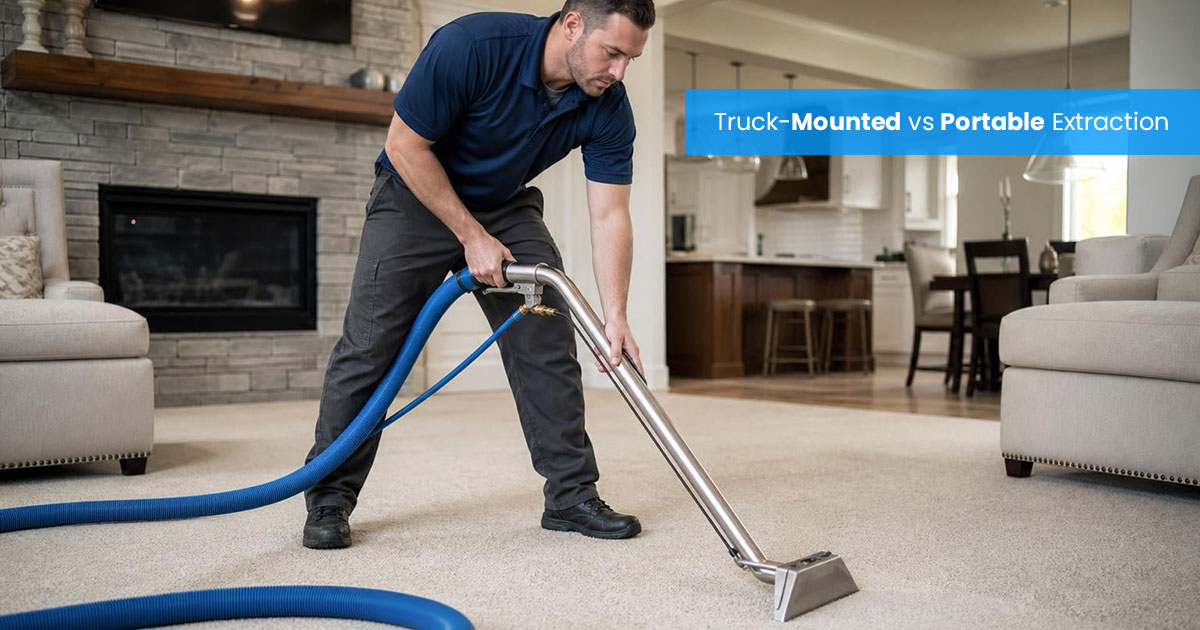
Truck‑Mounted vs Portable Extraction: Large‑Home Benefits
TL;DR
Truck-mounted extraction systems deliver higher water temperatures (200°F+), stronger suction (up to 200 inches of water lift), and faster production rates that make them the clear winner for large homes with extensive carpet. Portable extractors serve a purpose in apartments, upper floors, and tight-access situations, but they struggle with heat fade, frequent tank refills, and longer drying times when cleaning 4+ bedroom homes. On the Gold Coast, where subtropical humidity slows drying, the truck-mount’s superior moisture recovery also cuts mould and wicking risk.
Why This Glossary Exists
When you start calling carpet cleaners for a quote, you’ll hear terms like “hot water extraction,” “CFM,” “water lift,” and “truck-mounted system” thrown around as if everyone knows what they mean. Most people don’t, and that knowledge gap makes it harder to compare providers or understand why one approach costs more than another.
This glossary breaks down every term you’re likely to encounter when researching truck-mounted vs portable extraction benefits for large homes. Each definition includes a plain-English explanation and, where relevant, a note on why it matters specifically for bigger properties.
If you’d rather skip straight to booking, you can request a transparent quote with no hidden fees.
Quick Comparison: Truck-Mounted vs Portable at a Glance
|
Factor |
Truck-Mounted |
Portable |
|---|---|---|
|
Water temperature |
Up to 200°F+ (93°C+) |
120–150°F (49–66°C) |
|
PSI range |
400–1,500 |
100–500 |
|
Vacuum lift |
Up to 200 inches of water lift |
Up to 90 inches |
|
Production rate |
500–2,500 sq ft/hr |
300–500 sq ft/hr |
|
Typical dry time |
2–6 hours |
8–24 hours |
|
Noise inside home |
Low (engine stays outside) |
Higher (machine runs indoors) |
|
Power source |
Own engine or vehicle engine |
Home’s electrical outlets |
|
Best suited for |
Large homes, ground-floor access |
Upper floors, apartments, tight access |
These figures come from industry production-rate data and manufacturer specifications. The gap widens as the home gets larger, because portable machines lose heat over time, need more frequent tank emptying, and simply cannot sustain the same cleaning pace across 150+ square metres of carpet.
Glossary of Key Terms (A–Z)
Airflow (CFM)
Cubic Feet per Minute. This measures how much air the vacuum system moves through its hoses. Truck-mounted systems need high CFM because their hoses can stretch 50 metres or more from the van to the furthest room. Without enough airflow, suction weakens at the wand tip. Practitioners on cleaning forums point out that CFM is what “removes the air out of hundreds of feet of vacuum hose, so the lift can take over for your water pull.” For a large home, where hose runs are inevitably longer, this matters.
Carpet Wicking
Stains that reappear as the carpet dries. Wicking happens when soil or spill residue sits deep in the carpet backing and migrates upward through wet fibres. The longer a carpet stays wet, the more time wicking has to occur. Truck-mounted systems reduce wicking risk by extracting far more moisture during the cleaning pass, which shortens drying time considerably. This is especially relevant for pet urine stain removal, where deep contamination in the backing is common.
Detergent Residue / Re-soiling
Cleaning solution left behind in carpet fibres after extraction. That sticky residue attracts new dirt, making carpets look dirty again within weeks. Higher rinse pressure (300–400 PSI) flushes out more detergent, and truck-mounted systems comfortably exceed this threshold. A portable running at 100 PSI simply cannot rinse as thoroughly, which is why re-soiling complaints are more common after portable cleans.
Dwell Time
The period a pre-treatment chemical sits on the carpet before extraction begins. Both truck-mounted and portable operators use dwell time to loosen soil, but the higher solution temperatures from a truck-mount amplify the chemical’s effectiveness during this window. One widely cited cleaning principle states that for every 18 degrees above 118°F, the cleaning solution’s chemical action doubles.
Extraction
The act of pulling dirty solution and dissolved soil out of carpet fibres under vacuum. This is the core of any hot water extraction clean. Stronger extraction means less dirty water left behind, which translates directly to faster drying, less residue, and lower mould risk. When comparing truck-mounted vs portable extraction benefits for large homes, extraction power is the single biggest differentiator.
Heat Exchanger
A component in truck-mounted systems that heats water using waste heat from the vehicle’s engine (or a dedicated engine). This allows the system to sustain solution temperatures above 200°F continuously, without relying on the home’s hot water supply. Portables heat water with electric elements, which struggle to maintain temperature as tanks are refilled and the machine runs for extended periods across a large home.
Hose Run
The length of vacuum and solution hose stretching from the truck to the cleaning wand inside the home. Longer runs do lose some heat and suction, which is why CFM matters so much (see above). In a large home, a technician might need 30–50 metres of hose. A well-maintained truck-mount with high CFM compensates for this loss. Portables avoid long hose runs because the machine sits inside, but they sacrifice power to gain proximity.
Hot Water Extraction (HWE)
The gold-standard carpet cleaning method recommended by most carpet manufacturers. Heated water (or cleaning solution) is injected into carpet fibres under pressure, then immediately vacuumed out along with dissolved soil. Both truck-mounted and portable systems can perform HWE, but the quality of the clean varies enormously based on temperature, pressure, and suction strength. When people say “carpet steam cleaning,” they almost always mean hot water extraction.
Portable Extractor
A self-contained, electrically powered cleaning unit that the technician carries into the building. It holds its own solution tank, heater, pump, and vacuum motor. Premium portables (like a Mytee Lite III or Sapphire Scientific) can reach 210°F and pull around 6–13 inches of mercury, but most mid-range units top out well below that. Portables shine in situations where truck access is impossible.
Production Rate
Square footage (or square metres) cleaned per hour. Truck-mounted systems achieve 500 to 2,500 square feet per hour, while portables typically manage 300 to 500. For a 4-bedroom home with living areas, hallways, and stairs, this difference is dramatic. A truck-mount can finish in 90 to 120 minutes what takes a portable 2.5 to 4 hours. Lower production rates mean longer disruption to your household, and if you’re paying by the hour, higher cost.
PSI (Pounds per Square Inch)
A measurement of water pressure. Higher PSI pushes cleaning solution deeper into the carpet pile, agitates embedded soil more effectively, and rinses detergent residue more thoroughly. Truck-mounted systems operate between 400 and 1,500 PSI. Most portable extractors used for residential work sit between 100 and 500 PSI. That gap in rinse pressure is a major reason truck-mounted cleans produce less re-soiling.
Recovery Tank
The container that collects dirty extracted water. Truck-mounted units dump waste water into large onboard tanks (often 100+ litres), so the technician never has to pause and empty a bucket. Portable extractors carry much smaller recovery tanks, sometimes just 15–20 litres, meaning multiple interruptions to empty and refill during a large-home job. Each interruption adds time and breaks the cleaning rhythm.
Slide-In (Truck-Mount Type)
A self-powered truck-mount unit bolted into a van or ute tray. It runs its own dedicated engine rather than tapping the vehicle’s drivetrain. This design allows the vehicle to be turned off while the cleaning system operates. Slide-in units are common among professional operators who want maximum power without modifying their vehicle’s engine.
Solution Temperature
The heat of the cleaning solution measured at the wand tip, not at the machine. This distinction matters because heat is lost through long hose runs, especially in cooler weather. Truck-mounted systems compensate by generating water above 200°F at the source. Portables typically heat to 122–150°F and lose temperature faster. Because chemical action roughly doubles for every 10°C rise above 48°C (118°F), even a 20-degree difference at the wand tip has a noticeable impact on cleaning results.
Truck-Mounted Extraction System
A high-powered cleaning system permanently installed in a vehicle, driven by its own engine or the vehicle’s power take-off. It delivers superior heat, suction, and water capacity compared to any portable unit. The noise and bulk stay outside in the truck, so the cleaning process inside the home is quieter. For large homes, this system’s sustained performance across extended job times is its greatest advantage.
Vacuum Lift / Water Lift
A measurement of suction strength, expressed in inches of water column or inches of mercury. This is the spec that determines how much dirty water can actually be pulled out of carpet fibres. Truck-mount systems generate up to 200 inches of water lift. Most portables reach around 90 inches. Higher water lift means drier carpets after cleaning and faster overall drying times. As forum practitioners note, “the measurement that correlates with water pickup is lift.”
Wand
The handheld cleaning tool the technician pushes and pulls across the carpet surface. It connects to the truck (or portable) via solution and vacuum hoses. The wand injects hot solution and immediately extracts it. Wand quality and technique matter regardless of the system behind it, but a wand connected to a truck-mount benefits from the machine’s higher pressure and vacuum power.
Why Large Homes Favour Truck-Mounted Extraction
The truck-mounted vs portable extraction benefits for large homes comparison tilts heavily toward truck-mounted systems for properties with four or more bedrooms, multiple living areas, or extensive hallway runs. Here’s why.
Sustained performance over time. Portable extractors lose heat and cleaning effectiveness as the job stretches past the first hour. Tank refills introduce cold water. Electric heaters struggle to keep up. A truck-mount, powered by its own engine and heat exchanger, maintains consistent temperature and pressure from the first room to the last.
Faster completion, less disruption. A truck-mount can cut job time by up to 40% compared to a portable. For a large family home, that’s the difference between a two-hour job and a four-hour one. Less time means less furniture displacement, less foot-traffic planning, and an earlier return to normal life. To understand why professional cleaning matters more than DIY methods, that production-rate gap is the key.
Drastically shorter drying times. Carpets cleaned with a truck-mount typically dry in 2 to 6 hours, compared to 8 to 24 hours for portable systems. In a large home, you might have children, pets, or elderly family members who need to move through multiple rooms. Waiting a full day for carpets to dry is not practical.
No drain on your home’s resources. Truck-mounts use their own water supply and power. They don’t draw on your home’s electricity or hot water system, which matters during Gold Coast summers when your air conditioning is already working hard.
Multi-service efficiency. Truck-mounted equipment also powers tile and grout cleaning tools and upholstery attachments. For a large home, one visit can address carpets, tiled areas, and fabric furniture, saving coordination and cost.
Operators on Mikey’s Board (a well-known industry forum) put it bluntly: the customers who get their carpets cleaned regularly and refer others “expect a truck mount.” Production time is where truck-mounted systems dominate, even though a skilled operator can technically get carpets clean with either system.
When a Portable Extractor Makes More Sense
Portables aren’t inferior machines used by cut-rate operators. They fill a genuine gap.
If your home is an upper-floor apartment or a high-rise unit, hose runs from a truck parked at street level become impractical or impossible. A portable carried into the unit is the only realistic option. The same applies to townhouses with no ground-level parking access, commercial buildings with security restrictions, or heritage buildings with narrow stairwells.
Portables also work well for small callback spot treatments, single-room refreshes, and noise-sensitive environments like medical offices. One industry commentator noted that “you’re not going to want to leave a door open at a bank or lawyer’s office, where there can be valuable or sensitive material inside,” and a portable keeps the building sealed.
Most established carpet cleaning businesses carry both systems and choose based on the job. The question for homeowners with large, ground-accessible homes is straightforward: truck-mounted wins on every performance metric.
The Humidity Factor: Why This Matters on the Gold Coast
The Gold Coast’s subtropical climate creates a specific challenge that makes the truck-mounted vs portable extraction comparison even more one-sided for large homes.
High ambient humidity slows evaporation. Carpets that would dry in 4 hours in an arid climate might stay damp for 12 or more hours in a Gold Coast summer. That extended moisture window increases the risk of mould growth in carpet backing and underlay. It also extends the period during which carpet wicking can pull stains back to the surface.
Truck-mounted extraction removes significantly more water during the cleaning process, so carpets start drier and finish drying faster, even in humid conditions. For homes dealing with pet urine odour issues, this is doubly important: urine that has soaked into backing is extremely prone to wicking if drying takes too long.
Keeping indoor humidity in check is also easier when carpets aren’t releasing moisture all day. Pairing a professional carpet clean with regular air conditioner cleaning helps maintain a healthier indoor environment overall.
Making the Right Choice for Your Home
If your home has four or more bedrooms, mostly ground-floor access, and you live in a humid region like the Gold Coast, Logan, or Brisbane’s southern suburbs, truck-mounted extraction is the clear pick. It cleans faster, rinses deeper, dries quicker, and leaves less residue behind. Portables are the practical choice only when access makes truck-mounted systems physically impossible.
When speaking to carpet cleaning providers, ask these questions:
- What system do you use, truck-mounted or portable?
- What water temperature does your system reach at the wand?
- How long will my carpets take to dry?
- Do you carry enough hose length for my largest rooms?
The answers will tell you a lot about the quality of clean you can expect.
Frequently Asked Questions
Does truck-mounted carpet cleaning cost more than portable?
Sometimes slightly, but not always. The cost difference often reflects faster job completion rather than a higher hourly rate. Because truck-mounted systems clean 500 to 2,500 square feet per hour compared to 300 to 500 for portables, the total job time is shorter. Many operators price by room or square metre rather than by hour, so the cost may be comparable while the result is superior.
Can truck-mounted equipment reach my upstairs rooms?
Yes, in most cases. Technicians run hoses from the truck through the front door and up the stairs. The hose length can reach 30 to 50 metres, which covers most two-storey homes. Some suction and heat loss occurs over longer runs, but a properly maintained truck-mount compensates for this with its high CFM and water temperature. For homes beyond two storeys (or high-rises without lift access), a portable may be needed.
How long until I can walk on my carpets after truck-mounted cleaning?
Most truck-mount-cleaned carpets are dry enough for socked feet within 2 to 4 hours, and fully dry within 6 hours. Portable-cleaned carpets may take 8 to 24 hours. Running fans, opening windows, or keeping the air conditioning on will speed things up. Avoid placing furniture back on damp carpet, as this can cause colour transfer or rust marks from metal feet.
What if I live in a high-rise apartment?
A portable extractor is the practical choice. Hose runs from street level to an upper floor become too long for effective truck-mounted cleaning, and building management may not allow hoses through common areas. A good operator using a premium portable can still deliver solid results in a smaller space. The truck-mount advantage really kicks in for larger floor areas, which most apartments don’t have.
Is truck-mounted cleaning the same as steam cleaning?
In everyday language, yes. When Gold Coast homeowners search for “steam cleaning,” they’re almost always referring to hot water extraction, which is exactly what a truck-mounted system performs. True steam cleaning (dry vapour) is a different process used more in commercial sanitisation. The industry uses the terms interchangeably, but what matters is that heated water is injected into the carpet and immediately extracted under high vacuum.
Will truck-mounted cleaning remove pet stains and odours?
Truck-mounted systems are far better equipped for pet contamination because of their higher temperatures and stronger extraction. The heat breaks down urine crystals more effectively, and the powerful vacuum pulls more contaminated moisture from deep in the carpet backing. For severe cases, pre-treatment and specialised urine removal techniques may be needed alongside the extraction process.
Do I need to prepare my home before the technician arrives?
Moving small items, toys, and breakables off the floor helps the technician work efficiently. Most operators will move standard furniture (couches, dining chairs) as part of the service. Vacuuming beforehand isn’t required but can improve results since the extraction system is designed to remove embedded soil, not surface debris.
Ready to Book a Truck-Mounted Clean for Your Home?
Understanding these terms puts you in a stronger position when comparing quotes. For large homes on the Gold Coast, Logan, or surrounding areas, truck-mounted extraction consistently delivers faster drying, deeper soil removal, and better long-term results.
Get a transparent quote from a team that uses truck-mounted extraction every day, or browse the full range of services to see how one visit can cover carpets, tiles, upholstery, and more.