
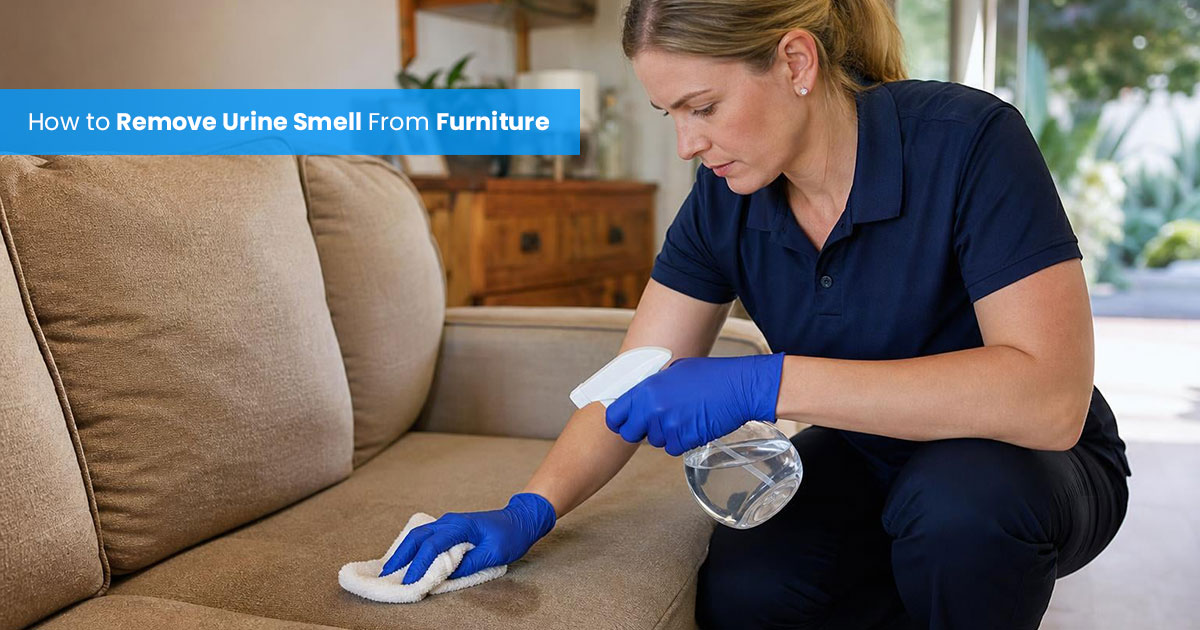
How to Remove Urine Smell From Furniture: 2026 Guide
Quick Answer
Urine smell sticks around because it leaves behind tiny crystals that regular cleaning can’t dissolve. These crystals reactivate every time humidity rises, which is why the smell keeps coming back, especially on the Gold Coast. The fix: use an enzymatic cleaner (not vinegar, not baking soda) and apply enough to soak as deep as the urine went. If the smell returns after two proper attempts, it’s time for professional extraction.
Urine on furniture is one of the most frustrating cleaning problems you can face. Whether it’s from a pet, a toddler, or an elderly family member, the experience is always the same: you clean it up, the smell fades, and two days later it’s back.
The reason is simple. Most cleaning products only cover up the smell. The actual source of the odour, tiny crystals left behind when urine dries, is still sitting in your cushion foam, waiting for a bit of moisture to fire back up.
This guide gives you a clear DIY process to actually fix the problem, explains why common home remedies fall short, and helps you decide when it’s worth calling in a professional.
If you already know the stain is beyond DIY, upholstery cleaning services with truck-mounted extraction equipment can reach contamination that surface treatments simply cannot.
Step-by-Step: How to Remove Urine Smell from Furniture
Follow these steps in order. Skipping ahead or taking shortcuts is usually why the smell comes back.
Step 1: Check Your Furniture’s Cleaning Code
Before you do anything, find the cleaning code tag on your furniture. It’s usually under the cushions or on the underside of the frame. This tells you what’s safe to use:
- W — Water-based cleaners are safe. You’re good to go with enzymatic cleaners and the steps below.
- S — Solvent only. Do NOT use water or water-based products, or you’ll get water rings, browning, and shrinkage. Call a professional.
- WS — Either water or solvent is fine. You can follow these steps.
- X — No liquids at all. Professional evaluation only.
If your furniture is coded S or X, stop here and skip to the “When to Call a Professional” section below. Using water on the wrong fabric can cause damage worse than the urine stain.
Step 2: Blot Up as Much as Possible
If the accident is fresh, grab paper towels or a clean microfibre cloth and blot firmly. Press straight down. Don’t rub. Rubbing pushes urine deeper into the fabric and spreads it sideways, making everything harder to fix.
Keep blotting with fresh towels until no more moisture transfers. For older, dried stains, skip to Step 3.
Step 3: Saturate with Enzymatic Cleaner
This is the most important step, and where most people go wrong.
An enzymatic cleaner contains live bacteria that eat the organic matter in urine and break those stubborn crystals into odourless byproducts (basically carbon dioxide and water). It’s the only product that permanently removes the smell rather than covering it up.
The key rule: use enough. Practitioners on Reddit and cleaning forums consistently say the number one mistake is under-applying. You need roughly double the volume of cleaner as there was urine. If the urine soaked through the fabric into the cushion foam, a light surface spray will do nothing. You need to soak the enzymatic cleaner in just as deep.
One user on MetaFilter warns that some enzymatic cleaners (like certain versions of Nature’s Miracle) leave behind a strong perfume scent that lingers for months. Anti Icky Poo and Bio One are frequently recommended as alternatives that don’t trade one smell problem for another. The takeaway: read reviews and avoid heavily fragranced formulas.
Step 4: Let It Dwell (Don’t Rush This)
Cover the wet area with a damp cloth or plastic wrap to keep it moist. The enzymes need time to work, usually 8 to 24 hours. If the solution dries out before it finishes breaking down the urine, you’ll get incomplete results.
Do not use heat to speed up drying. No hair dryers, no heaters, no direct sunlight. Heat sets protein-based stains permanently into fabric. Once heat-set, even professional cleaning becomes less effective.
Step 5: Blot and Air Dry
After the dwell time, blot up the excess moisture with clean towels. Let the area air dry completely. A fan pointed at the furniture (not a heater) helps speed this up safely.
Step 6: Apply Baking Soda (Optional Finishing Step)
Once fully dry, sprinkle baking soda over the area and leave it for a few hours or overnight. Baking soda absorbs any lingering surface odour. Vacuum it up thoroughly.
Baking soda on its own won’t remove urine smell. It’s a useful finishing touch after enzymatic treatment, not a replacement for it.
Step 7: Repeat if Needed (But Know Your Limit)
One round of enzymatic treatment often does the job for fresh stains. Older or deeper stains may need a second application.
If the smell comes back after two proper attempts (with enough product, enough dwell time, and the right technique), the urine has almost certainly soaked deep into the cushion foam. At that point, DIY has reached its limit and professional extraction is the reliable next step.
Why the Smell Keeps Coming Back (The Short Version)
You don’t need a chemistry degree to understand this, but knowing the basics helps you avoid wasting money on products that don’t work.
When urine dries, it leaves behind tiny crystals called uric acid crystals. These crystals are the core of the problem because:
- They don’t dissolve in water. Soap, vinegar, and regular cleaning sprays can’t break them down.
- They reactivate in humidity. Every time moisture hits them, they release a fresh wave of urine odour. On the Gold Coast, where humidity regularly exceeds 70%, this happens constantly.
- They bond to fabric and foam. They lock onto the fibres at a molecular level, which is why scrubbing the surface doesn’t help.
Enzymatic cleaners are the only household product that actually breaks these crystals apart. Everything else (vinegar, baking soda, air fresheners, Febreze) just masks the smell temporarily.
For a deeper look at how this works on carpet, see our urine odour removal expert guide.
Why Common Home Remedies Fall Short
Vinegar
A 1:1 mix of white vinegar and water is probably the most-recommended home remedy on the internet. It can help with very fresh accidents on sealed surfaces, but it cannot dissolve uric acid crystals. On older stains that have soaked into foam, vinegar is largely ineffective. It’s fine as a first response if you don’t have enzymatic cleaner on hand, but it’s not a permanent fix.
Baking Soda Alone
Baking soda absorbs some surface odour, which is why it seems to work at first. But it can’t reach into foam, and it can’t break down the crystals causing the smell. Useful as a supplement, not a solution.
Hydrogen Peroxide Mixes
You’ll find recipes combining hydrogen peroxide, baking soda, and dish soap. These can help with surface stains, but hydrogen peroxide can bleach upholstery and weaken fabric fibres. Detergent residue left behind attracts dirt over time, leaving the area looking grimy within weeks. If you try this route, always spot-test on a hidden area first.
Air Fresheners and Scented Sprays
These layer a pleasant scent on top of the bad one. The urine compounds remain completely intact. Once the fragrance wears off, you’re back where you started. This is the difference between masking an odour and actually neutralising it.
Cat Urine vs. Dog Urine: Why It Matters
If you’re dealing with cat urine, you’re facing a harder problem. Here’s why:
Cat urine is more concentrated. Cats evolved as desert animals that conserve water. Their urine is thicker, with more odour-causing compounds per drop.
Cat urine contains a unique compound. An amino acid called felinine breaks down into sulphur compounds, the same class of chemicals that make skunk spray smell so terrible. This is why cat urine has that distinctive, overwhelming stench that dog urine just doesn’t match.
Diet plays a role. Cats are obligate carnivores, so their urine contains more nitrogen, which produces more ammonia as it breaks down.
Intact male cats spraying to mark territory produce the strongest odour of all.
The good news: the same enzymatic cleaner approach works. You just may need more product, more dwell time, and possibly professional help sooner. For cat-specific tips, our guide on cat urine smell on furniture goes into more detail.
How to Find Hidden Urine Stains
Can smell it but can’t see it? Pick up a UV blacklight (available at most hardware stores for under $20). In a dark room, shine it over your furniture. Urine stains glow as yellow, green, or blue patches.
One thing to know: urine actually etches the fabric fibres, so the glow can persist even after successful cleaning. Professional cleaners point this out regularly to customers. The phosphorus left from urine breakdown bonds to fibres like a dye. After cleaning, use your nose, not the blacklight, to confirm the odour is gone.
When to Call a Professional: A Simple Decision Guide
DIY will probably work if:
- The accident happened within the last hour or two
- The stain is on the surface and hasn’t reached the foam
- Your fabric is coded W or WS
- It’s a one-time accident, not a spot your pet returns to
Call a professional if:
- The stain is more than 48 hours old
- Urine has soaked into cushion foam (you can feel dampness inside, or the smell is strong even after surface cleaning)
- The smell returns after two proper enzymatic treatments
- Your fabric is coded S or X
- You’re dealing with cat urine on a spot that’s been marked repeatedly
- You live on the Gold Coast or in a humid climate where the smell keeps reactivating
What Professional Cleaning Actually Does
Professional upholstery cleaners use truck-mounted equipment that generates far more heat and suction than anything you can rent or buy. They inject cleaning solution deep into cushion foam, let it break down the contamination, then extract it with industrial-strength vacuum suction. This reaches places no surface spray or household wet-vac can touch.
The process typically includes a pre-treatment (applying enzymatic or specialised solutions and giving them time to work before extraction), which is what makes the extraction itself so much more effective.
If deep-soaked cushions are the issue, professional cleaning also avoids the mould risk that comes from DIY attempts. When you saturate foam with cleaning solution at home, it’s very difficult to extract all that liquid. If it stays trapped inside, you can end up with mould growth, creating a second problem on top of the first.
For Gold Coast residents dealing with persistent urine odour, professional upholstery cleaning with truck-mounted extraction addresses the foam penetration and humidity reactivation issues that make this region particularly tough for DIY. If you want to understand the equipment difference, our comparison of truck-mounted vs. portable extraction breaks it down.
How to Prevent Future Accidents from Causing Damage
Use Couch Covers or Waterproof Liners
The simplest protection. A removable, washable cover catches accidents before they reach the foam. Waterproof liners placed under cushion covers add another layer, keeping liquid from soaking through at all.
Consider Fabric Protector Treatment
Professional fabric protector creates a barrier that makes liquids bead up instead of soaking in immediately. It doesn’t make furniture urine-proof, but it buys you critical extra minutes to grab a towel and blot.
Break the Re-Marking Cycle
If your pet can still smell their urine on the furniture, they’ll keep going back. This is why thorough enzymatic cleaning matters for prevention too. If any uric acid crystals remain, your pet can detect them even when you can’t. Clean the spot thoroughly, then block access to the area for a few days while the enzymatic cleaner finishes its work.
Fabric-Specific Tips
Leather: Urine usually wipes off the surface with a manufacturer-approved leather cleaner, followed by conditioner to prevent drying. The bigger worry is urine seeping through seams into the foam underneath.
Microfiber: Usually coded S or WS. Alcohol-based cleaners or products made for synthetic fabrics work well. Check the tag first.
Polyester and nylon blends: Typically W-coded, making them the easiest fabrics to treat with enzymatic cleaners.
If the issue extends to your mattress, our guide to urine smell removal from mattresses covers the same foam-penetration problem.
Frequently Asked Questions
Why does my couch still smell like urine after I cleaned it?
Almost certainly because of uric acid crystals trapped in the cushion foam. Regular cleaning products can’t dissolve them, and they reactivate whenever humidity rises. You need an enzymatic cleaner applied in enough volume to reach as deep as the urine went, or professional extraction for severe cases.
Does vinegar remove urine smell from furniture permanently?
Not usually. Vinegar can help with very fresh, surface-level spills, but it can’t break down the crystals that cause long-term odour. On anything beyond a fresh accident, enzymatic cleaner is what you need.
Is cat urine harder to remove than dog urine?
Yes, significantly. Cat urine is more concentrated, contains more ammonia-producing nitrogen, and includes a unique compound (felinine) that breaks down into sulphur chemicals similar to skunk spray. Same treatment approach, but expect to need more product and possibly professional help. Our guide on cat urine smell removal covers this in detail.
How much enzymatic cleaner do I actually need?
More than you think. The general rule from cleaning professionals is roughly double the volume of urine that was deposited. If a cat urinated a cup’s worth into a cushion, you need about two cups of enzymatic cleaner saturated into the same area. The cleaner has to reach everywhere the urine went.
Can I use baking soda to remove urine smell from a couch?
On its own, no. Baking soda absorbs some surface odour but doesn’t break down the crystals causing the smell. It works well as a finishing step after enzymatic treatment (sprinkle, wait, vacuum), but it won’t solve the problem by itself.
What do the cleaning code letters on my furniture mean?
W means water-based cleaners (including enzymatic cleaners) are safe. S means solvent only, and using water will cause damage. WS means either method works. X means no liquids at all. Always check before applying anything.
Does the Gold Coast climate make urine odour worse?
Yes. The subtropical humidity means those uric acid crystals are constantly exposed to moisture, triggering the smell over and over. DIY treatments that work fine in drier parts of Australia often fail here because the crystals never fully go dormant. This is a big reason Gold Coast residents end up needing professional upholstery cleaning more often than homeowners in drier climates.