
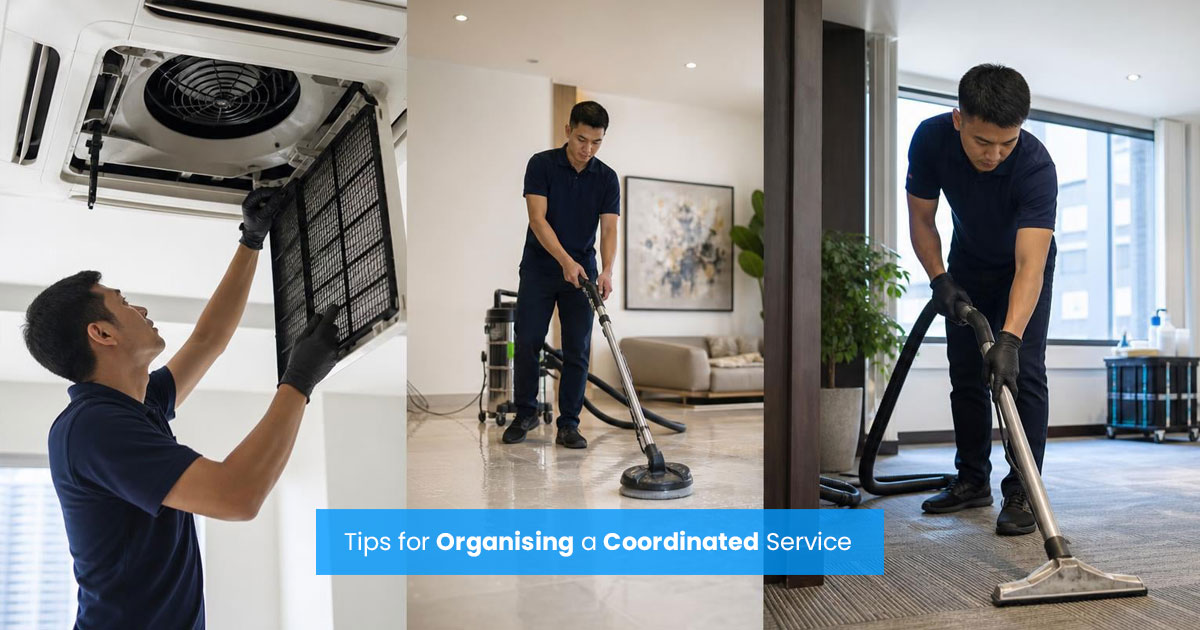
Tips for Organising a Coordinated Service Visit 2026 Guide
TL;DR
A coordinated service visit combines carpet cleaning (including carpet tiles), air conditioner cleaning, and tile/grout cleaning into a single planned appointment. The correct sequence is AC first, hard tile second, carpet or carpet tiles last. This order prevents cross-contamination and uses the freshly cleaned AC to speed up carpet drying. Bundling services with one provider typically saves 10-20% compared to booking separate vendors, whether you manage a home, rental property, or commercial space.
Every building, whether a three-bedroom home in Burleigh Heads or an office fit-out in Southport, accumulates the same problems over time. Carpets and carpet tiles trap soil. Grout darkens. Split systems circulate dust and mould spores instead of clean air. The difference between residential and commercial settings isn’t the problem. It’s the scale and the scheduling pressure.
Property managers juggling multiple tenancies, office managers keeping workspaces presentable, and homeowners preparing for inspections all face the same coordination challenge: how do you get carpet cleaning, tile and grout cleaning, and AC servicing done efficiently without spreading the disruption across multiple days and multiple vendors?
That’s what a coordinated service visit solves. This guide covers the right service sequence, preparation for both residential and commercial spaces, post-cleaning maintenance (including carpet tile care programs), and how Gold Coast conditions shape every decision.
Get a combined service quote from a single provider to simplify the entire process.
What Is a Coordinated Service Visit?
A coordinated service visit is when you schedule multiple cleaning services, typically carpet or carpet tile cleaning, air conditioner cleaning, and hard tile/grout cleaning, into one appointment with one provider. Instead of booking three separate companies on three separate days, everything happens in a planned sequence during a single visit.
The concept sounds simple, but the execution requires planning. Each service involves different equipment, different drying times, and different preparation steps. Done in the wrong order, one service can undo the results of another. Done right, the services complement each other and reduce total downtime for the space.
When Do People Book Coordinated Visits?
Five situations drive the majority of coordinated service bookings:
End-of-lease deadlines. Renters and property managers on the Gold Coast often need carpet cleaning, tile cleaning, and sometimes pest control completed before final inspections. Missing any one of these can cost part of the bond. End-of-lease carpet cleaning is one of the most common triggers for bundling services together.
Scheduled commercial maintenance cycles. Office managers and facility managers build carpet tile maintenance, AC servicing, and hard floor care into quarterly or biannual programs. Coordinating these into single visits minimises workplace disruption and keeps maintenance costs predictable.
Seasonal deep cleans. Spring (September through November) is the most popular window for both homes and commercial spaces. Getting the AC serviced before the heavy cooling season means it runs efficiently when temperatures climb, and cleaning carpets and tiles before summer keeps spaces fresh.
Property changeovers. Whether it’s a rental turnover, a new commercial tenant moving in, or a home sale, vacant properties are the easiest to service in a single session because every surface is accessible.
Post-event or high-traffic recovery. Retail spaces after holiday shopping seasons, offices after busy periods, or homes after entertaining all benefit from a full reset across carpets, tiles, and air systems simultaneously.
Glossary of Key Terms
Understanding these terms helps you communicate clearly with your service provider and make better decisions when organising a coordinated visit, whether for a home, rental portfolio, or commercial premises.
Coordinated Service Visit
Scheduling two or more professional cleaning services (carpet, carpet tiles, AC, hard tile/grout, upholstery) into one planned appointment with one provider. The goal is to reduce total time, cost, and the coordination burden of managing multiple vendors.
Hot Water Extraction (HWE) / Steam Cleaning
The industry-standard method for deep carpet and carpet tile cleaning. Despite the name “steam cleaning,” it uses hot water injected into the carpet under pressure, then immediately extracted along with dissolved soil. Professional-grade hot water extraction equipment removes up to 94% of common allergens per clean. This is the method recommended by most carpet tile manufacturers for periodic deep cleaning.
Truck-Mounted Equipment
Cleaning machinery permanently installed in a service vehicle, drawing power from the truck’s engine rather than a household power outlet. This produces significantly higher water temperatures and stronger suction than portable units, resulting in deeper soil extraction and faster drying times. For a full comparison of truck-mounted vs portable extraction, see the dedicated guide.
Carpet Tiles (Modular Carpet)
Square carpet modules (typically 500mm x 500mm) commonly used in offices, retail spaces, and some modern homes. Carpet tiles collect soil in the same way broadloom carpet does, but their modular design allows individual tiles to be lifted, rotated, or replaced. Regular maintenance programs, including vacuuming schedules, interim cleaning, and periodic hot water extraction, significantly extend their lifespan.
Soil Removal and Soil Load
Soil refers to all contaminants trapped in carpet or carpet tile fibres: dry particulate (sand, dust, grit), oily residues (skin oils, cooking vapours), and biological matter (allergens, bacteria). On the Gold Coast, sand and salt from coastal air contribute to higher soil loads than inland locations. Effective maintenance programs focus on removing soil before it works deep into the fibre pile, where it causes premature wear.
Tile and Grout Cleaning
Professional hard tile cleaning uses high-temperature water and high-pressure tools to strip embedded dirt, mould, and grime from tile surfaces and grout lines. This is fundamentally different from regular mopping, which only addresses the surface. Professional methods can achieve up to 96.5% allergen removal from tile and grout surfaces.
Split System Clean
A deep clean of a split-system air conditioner, the wall-mounted type common in Gold Coast homes and offices. This involves cleaning the filters, coils, fan barrel, and drain line, then sanitising the unit to remove mould, bacteria, and dust buildup. Learn more about why professional AC cleaning matters for indoor air quality.
Service Bundling
Combining multiple cleaning services into a single booking with one provider. Industry data suggests bundled services typically cost 10-20% less than booking each service separately, thanks to shared travel costs, reduced admin overhead, and volume pricing.
Drying Time
The period after carpet or carpet tile cleaning when the fibres and backing are still damp. For hot water extraction, this typically ranges from 6 to 12 hours. The IICRC (the carpet cleaning industry’s standards body) recommends drying occur within 6 to 8 hours and must not exceed 24 hours to prevent mould growth. In commercial settings, after-hours cleaning schedules allow carpets to dry overnight before staff return.
Cross-Contamination (Between Services)
When one cleaning task undoes or degrades the results of another. The most common example: running a dirty air conditioner after cleaning the carpets, which blows dust and mould spores onto the freshly cleaned fibres. Proper sequencing eliminates this problem entirely.
Transparent Quote
A pricing approach where the quoted price is the final price, with no hidden fees, surprise surcharges, or pressure to add services on the day. This matters especially for coordinated visits where multiple services are involved and costs can become unclear across line items.
The Right Sequence: What Gets Cleaned First?
This is the single most important tip for organising a coordinated service visit with carpet, AC, and tile work. The order matters because each service affects the environment the next one operates in. This applies equally to a single residence and to a 200-square-metre office with carpet tiles throughout.
Step 1: Air Conditioner / Split System Clean
AC cleaning comes first. Always.
Air conditioner coils and filters accumulate dust, mould, and soot over months of use. When technicians clean the unit, some of that debris inevitably enters the room. If your carpets or carpet tiles are already clean, that debris lands on freshly cleaned fibres.
There’s also a phenomenon professionals call “candle sooting,” where black residue around air vents stains the carpet in a ring pattern. Cleaning the split system first removes the majority of this soot before any floor work begins.
AC cleaning involves no floor moisture. The technician works on the wall-mounted indoor unit, flushing the coils and drain line. The floor stays dry, which means tile and carpet work can follow without delay.
A practical bonus: once the AC is serviced, it runs more efficiently. You’ll need that clean, powerful airflow later to dry the carpets.
Step 2: Hard Tile and Grout Cleaning
Tile cleaning comes second because it uses high-pressure water on hard surfaces. There can be splash and minor run-off during the process, but hard tile dries quickly, often within an hour or two.
Professional tile and grout cleaning is typically done in bathrooms, kitchens, entryways, and (in commercial settings) break rooms and foyers. Doing this before carpet cleaning means any overspray or tracked moisture won’t affect carpet that hasn’t been cleaned yet.
Step 3: Carpet and Carpet Tile Cleaning Last
Carpet cleaning is the wettest process and has the longest drying time (6 to 12 hours). It goes last for two reasons.
First, both the AC and hard tile work are already done, so there’s no risk of debris or moisture from those jobs landing on clean carpet fibres. Second, the freshly serviced AC unit can now run at full efficiency to circulate dry air and pull moisture from the room, speeding up drying considerably.
Practitioners on the Truck Mount Forums report achieving 3 to 6 hour dry times with professional equipment under good conditions. One experienced cleaner noted that carpets with protector applied take 6 to 8 hours, while those without protector dry in 4 to 6.
For carpet tiles in commercial settings, drying is often faster because the tiles sit on a hard substrate with less backing material to hold moisture. After-hours scheduling allows carpet tiles to dry overnight, so the office is ready for foot traffic the next morning.
For a deeper look at the carpet cleaning process, including how truck-mounted equipment works, check the dedicated service page.
How to Prepare Your Space Before a Coordinated Visit
Preparation for a multi-service visit requires more planning than a single-service appointment. The specifics differ between residential and commercial settings.
General Preparation (All Settings)
Move fragile or valuable items. Technicians will be moving through multiple rooms with equipment and hoses. Remove breakables, electronics, and anything delicate from the cleaning zones.
Clear access paths. Hoses run from the truck to the work areas. A clear path from the front entrance through hallways matters more when three services are being performed in sequence.
Communicate the scope. Walk through the property and identify specific problem areas before the team arrives. Stained grout, high-traffic carpet zones, pet odour spots, AC units that smell musty: flagging these in advance lets the team plan their pre-treatments and allocate time correctly.
Residential Preparation
Secure pets. Doors will be propped open during cleaning, and equipment noise can stress animals. Put pets in a closed room that isn’t being serviced, or arrange for them to be out of the house.
Light furniture. Technicians typically move small, light furniture like dining chairs and side tables. Larger pieces like beds, heavy bookshelves, and entertainment units should be moved before the visit if they’re in a cleaning zone.
Light vacuum carpets. A quick vacuum removes surface-level debris so the hot water extraction process can focus on deep-set soil.
Commercial and Office Preparation
Schedule after hours when possible. For offices with carpet tiles, scheduling the visit after business hours avoids disruption to staff and allows full drying time overnight. This is especially important for reception areas and open-plan workspaces where foot traffic would immediately re-soil damp carpet tiles.
Move wheeled furniture. Desk chairs, mobile pedestals, and any items on castors should be rolled off the carpet tile areas being cleaned. Conference tables and fixed desks usually stay in place.
Notify building management. In multi-tenancy buildings, the cleaning team may need after-hours access, loading dock use for the truck-mounted unit, or lift access. Sort this out before the appointment.
Identify high-soil zones. Entryways, corridors, and areas around kitchenettes accumulate soil far faster than perimeter offices. Pointing these out ensures the team applies pre-treatment where it matters most.
AC-Specific Preparation
Turn off the air conditioner before the technician arrives. Clear at least one metre of space below and around each indoor head unit. The cleaning process involves water and foam treatments on the coils, so placing a towel or plastic sheet beneath the unit protects flooring. Your technician will handle this, but clearing access makes the job faster.
Tile-Specific Preparation
Remove bath mats, rugs, and loose items from tiled areas. Clear products off the shower floor if shower tiles are being cleaned. Point out specific grout stains or mouldy sections before work begins.
What to Expect During the Visit
For a standard three-bedroom Gold Coast home with all three services (AC, tile, carpet), expect the visit to take roughly 3 to 5 hours. For a small to mid-sized commercial space (100 to 300 square metres of carpet tile with two or three AC units and a tiled break room), expect 4 to 6 hours.
The AC Phase (30-60 Minutes Per Unit)
The technician opens the indoor unit, removes and cleans filters, applies foam treatment to the evaporator coils, cleans the fan barrel, and flushes the drain line. The unit is then sanitised and reassembled. Once finished, the AC can be turned on immediately.
In commercial spaces with multiple split systems, this phase takes proportionally longer but can often overlap with other preparation work.
The Tile Phase (Varies by Area)
Pre-treatment solution goes onto the grout lines first, sitting for several minutes to loosen embedded grime. Then high-pressure, high-temperature extraction cleans both the tile surface and grout. Kitchens, bathrooms, break rooms, and foyers are the most common areas. The result is usually dramatic, particularly on light-coloured grout that has darkened over time.
The Carpet and Carpet Tile Phase (5-10 Minutes Active Cleaning Per Room/Zone)
Active carpet cleaning time is surprisingly quick, roughly 5 to 10 minutes per room for the actual extraction pass. The technician pre-treats stains and high-traffic areas, then makes systematic passes with the wand, injecting hot water and immediately extracting it. Truck-mounted systems generate water temperatures above 200 degrees Fahrenheit and powerful suction that portable machines cannot match. This combination removes more soil and significantly reduces drying time.
For carpet tiles, the process is the same as broadloom carpet but with some advantages. Individual tiles that are heavily stained or damaged can be lifted and replaced rather than cleaned, saving time and producing a more uniform result. The technician can also focus extraction on high-traffic zones (typically entryways and corridors) while doing lighter passes on low-traffic perimeter areas, matching the cleaning intensity to the actual soil load.
After the Visit: Drying and Maintenance for Gold Coast Conditions
Post-visit care is where many people, residential and commercial alike, make mistakes. The Gold Coast’s subtropical climate works against you if you’re not prepared.
Carpet and Carpet Tile Drying
The Gold Coast’s average humidity sits between 67 and 75% during summer and rarely drops below 62% even in winter. High humidity slows carpet drying because the surrounding air is already saturated with moisture and can’t absorb much more.
To speed drying:
- Run your freshly cleaned AC on cooling mode. This pulls moisture from the air and creates circulation, exactly what damp carpet needs.
- Open windows if the outdoor humidity is lower than indoor levels (more common in winter or on dry, breezy days).
- Use fans pointed across the carpet surface to keep air moving.
- Restrict foot traffic for at least 6 hours on residential carpet and until the next business day for commercial carpet tiles.
- Wait 24 hours before placing heavy furniture back on cleaned carpet.
Mould can begin growing within 24 to 48 hours if carpet stays wet. This is why the IICRC sets a hard ceiling of 24 hours for drying and recommends the 6 to 8 hour window as the target.
Carpet Tile Maintenance Between Professional Cleans
Professional hot water extraction is only part of a complete carpet tile maintenance program. Between deep cleans, these practices dramatically extend carpet tile life and appearance:
Daily vacuuming in high-traffic areas. Entryways, corridors, and common areas in offices should be vacuumed daily. Dry soil is abrasive, and every footstep grinds grit deeper into the fibre, causing permanent wear. A good vacuum program removes up to 80% of soil before it becomes embedded.
Weekly vacuuming in low-traffic zones. Perimeter offices, meeting rooms used only occasionally, and storage areas need less frequent attention but shouldn’t be neglected entirely.
Spot cleaning within 24 hours. Spills on carpet tiles should be blotted (never rubbed) and treated with an appropriate spotter as soon as possible. The longer a spill sits, the harder it becomes to remove. Having a spot cleaning kit accessible to staff in commercial settings prevents small spills from becoming permanent stains.
Entrance matting. Up to 85% of soil enters a building on the soles of shoes. Quality entrance mats at every external door, sized to allow at least three footsteps, are the single most effective thing you can do between professional cleans. On the Gold Coast, where sand is a constant companion, this is not optional.
Carpet tile rotation. One advantage of modular carpet tiles is the ability to rotate tiles from high-wear areas (in front of desks, along walkways) to lower-traffic zones. This distributes wear evenly and extends the life of the entire installation. Some facility managers rotate tiles every 6 to 12 months as part of their maintenance calendar.
Hard Tile Care After Cleaning
Tile surfaces dry much faster than carpet, usually within an hour or two. Avoid heavy mopping for 24 hours to let any sealant or residual cleaning agents fully settle. Walk normally once the surface feels dry to the touch.
For commercial tiled areas (break rooms, bathrooms, foyers), resuming regular maintenance mopping after 24 hours is fine. The professional clean resets the grout to a baseline, and consistent daily or weekly mopping keeps it there.
AC After Cleaning
Use your air conditioner immediately. Running it right after the visit serves double duty: you benefit from cleaner, healthier airflow while the AC simultaneously helps dry your carpets. This is one of the most overlooked tips for organising a coordinated service visit, and it’s the practical reason the AC-first sequence pays off.
Why One Provider Beats Three
Coordinating carpet, AC, and tile cleaning across three different companies means three different schedules, three different arrival windows, three different invoices, and three different people to call when something goes wrong. This is inconvenient for homeowners and genuinely costly for property managers running multiple properties.
The Accountability Gap Problem
When you use multiple vendors, problems that fall between service scopes become no one’s responsibility. A stain near the tile-carpet transition? The carpet cleaner says it was there before. The tile cleaner says it’s outside their area. With a single provider, there’s one team accountable for the entire result.
For property managers and office managers, this single point of accountability simplifies reporting and means fewer back-and-forth calls when an issue arises.
Cost Savings Are Real
Consolidated vendors typically offer 10-20% lower total costs compared to separately procured services. The savings come from bundled pricing, shared travel time (one trip instead of three), and reduced administrative overhead. For a full-home coordinated visit, that discount adds up. For a property manager coordinating services across five or ten rental properties, the cumulative savings are substantial.
One Quote, One Visit, One Contact
The practical convenience of a single point of contact shouldn’t be underestimated. One phone call to book. One quote to review. One team that knows the full scope of work and can adjust on the day if something takes longer or a new issue is discovered.
You can also add services like upholstery cleaning to a coordinated visit, since the equipment and team are already on-site. This makes the per-service cost even more efficient.
Recommended Frequencies for Gold Coast Properties
Getting the timing right matters as much as getting the sequence right. The Gold Coast’s coastal environment (humidity, sand, salt air) accelerates soil buildup and mould growth compared to inland locations.
Residential Properties
|
Service |
Standard Home |
Homes with Pets/Children |
End-of-Lease |
|---|---|---|---|
|
Carpet steam clean |
Every 12 months |
Every 3-6 months |
Before final inspection |
|
Tile and grout clean |
Every 12-18 months |
Every 12 months |
Before final inspection |
|
AC deep clean |
Every 12 months |
Every 12 months |
Recommended before handover |
Pre-summer (September to November) is the best window. Humidity is lower than peak summer, meaning faster carpet drying. Getting the AC serviced before the heavy cooling season means it runs efficiently when you need it most.
End-of-lease periods peak in December through January and again in June through July. Book your coordinated visit at least two weeks before the final inspection to leave buffer time if something needs a second pass.
Commercial Properties (Offices, Retail, Shared Spaces)
|
Service |
Light Traffic |
Moderate Traffic |
Heavy Traffic (Retail/Reception) |
|---|---|---|---|
|
Carpet tile deep clean (HWE) |
Every 12 months |
Every 6 months |
Every 3-4 months |
|
Interim carpet tile clean |
Every 6 months |
Every 3 months |
Monthly |
|
Tile and grout clean |
Every 12 months |
Every 6-12 months |
Every 3-6 months |
|
AC deep clean |
Every 12 months |
Every 12 months |
Every 6-12 months |
For commercial spaces, pairing the deep carpet tile clean with AC servicing in a single after-hours visit is the most practical approach. The AC runs overnight to dry the carpet tiles, and the space is ready for business the next morning.
Tips for Organising a Coordinated Service Visit: Quick Reference Checklist
Here’s a condensed version of the key tips covered in this guide:
- Book with one provider that offers carpet, AC, and tile services to avoid coordination headaches and save 10-20%.
- Sequence correctly: AC first, hard tile second, carpet/carpet tiles last.
- Move furniture, equipment, and fragile items before the team arrives.
- Secure pets (residential) or notify building management (commercial) ahead of time.
- Vacuum carpets and carpet tiles and remove loose items from tiled areas.
- Turn off the AC and clear space around indoor head units.
- Point out specific stains, high-soil zones, or problem areas to the technician at the start.
- Run the AC on cooling mode after the visit to accelerate carpet drying.
- Wait 6 hours (residential) or until the next business day (commercial) before resuming normal foot traffic on carpet.
- Maintain carpet tiles between deep cleans with daily vacuuming, spot cleaning, entrance matting, and periodic tile rotation.
- Book 2+ weeks ahead for end-of-lease or peak season visits.
Request a coordinated service quote and get everything handled in one visit.
Frequently Asked Questions
How long does a coordinated service visit take?
For a typical three-bedroom Gold Coast home with two to three AC units, one or two tiled wet areas, and fully carpeted bedrooms and living areas, expect 3 to 5 hours total. For a small commercial office (100 to 300 square metres), expect 4 to 6 hours. Exact time depends on the size of each area and how heavily soiled the surfaces are.
Why should air conditioner cleaning come before carpet cleaning?
Dirty AC units circulate dust, mould spores, and soot. If you clean the carpets first and then run the AC, those particles settle onto the freshly cleaned fibres. Cleaning the AC first eliminates this cross-contamination risk, and the serviced unit then helps dry carpets faster afterward.
How long do carpets and carpet tiles take to dry on the Gold Coast?
Under typical Gold Coast humidity conditions (67-75% in summer), carpets cleaned with hot water extraction take 6 to 12 hours to dry. Using a clean AC unit, fans, and good ventilation can bring this closer to the 4 to 6 hour range. Carpet tiles often dry faster than broadloom carpet due to their thinner construction. The IICRC standard requires drying within 24 hours maximum, with 6 to 8 hours as the recommended target.
Is it cheaper to bundle carpet, AC, and tile cleaning together?
Yes. Bundling with a single provider typically costs 10-20% less than booking three separate vendors. Savings come from shared travel costs, combined labour, and volume discounts. You also save time by managing one booking instead of three, which is especially valuable for property managers handling multiple properties.
Can I walk on the carpet immediately after cleaning?
It’s best to wait at least 6 hours before walking on freshly cleaned carpet, and wear clean socks if you must walk on it sooner. Wait a full 24 hours before placing heavy furniture back. For commercial carpet tiles cleaned after hours, restrict access until the next morning. Walking on damp carpet too soon attracts new soil and slows the drying process.
How often should carpet tiles be professionally cleaned?
This depends on traffic volume. Low-traffic office areas can go 12 months between deep cleans. Moderate-traffic areas should be cleaned every 6 months. High-traffic zones like reception areas, retail spaces, and corridors need professional extraction every 3 to 4 months. Between deep cleans, daily vacuuming and prompt spot cleaning are essential to prevent soil from grinding into the fibres.
What if I only need two of the three services?
A coordinated visit works with any combination. Carpet and tile cleaning together is common for end-of-lease situations. Carpet and AC cleaning together is popular for seasonal deep cleans. The sequencing principles still apply: AC before carpet, hard tile before carpet.
What’s the best maintenance routine between professional carpet tile cleans?
Focus on four things: daily vacuuming in high-traffic areas, immediate spot cleaning of spills (blot, don’t rub), quality entrance mats at every external door (especially important near Gold Coast beaches), and rotating tiles from high-wear zones to low-traffic areas every 6 to 12 months. This combination prevents premature wear and keeps carpet tiles looking consistent between professional deep cleans.
Do I need to be present during the entire visit?
You should be present at the start to walk the technician through your priorities and point out any problem areas. Many homeowners then leave and return when the work is done. For commercial spaces, a designated contact person should be available by phone even if they’re not on-site. Make sure the team has access to all areas before you leave.