
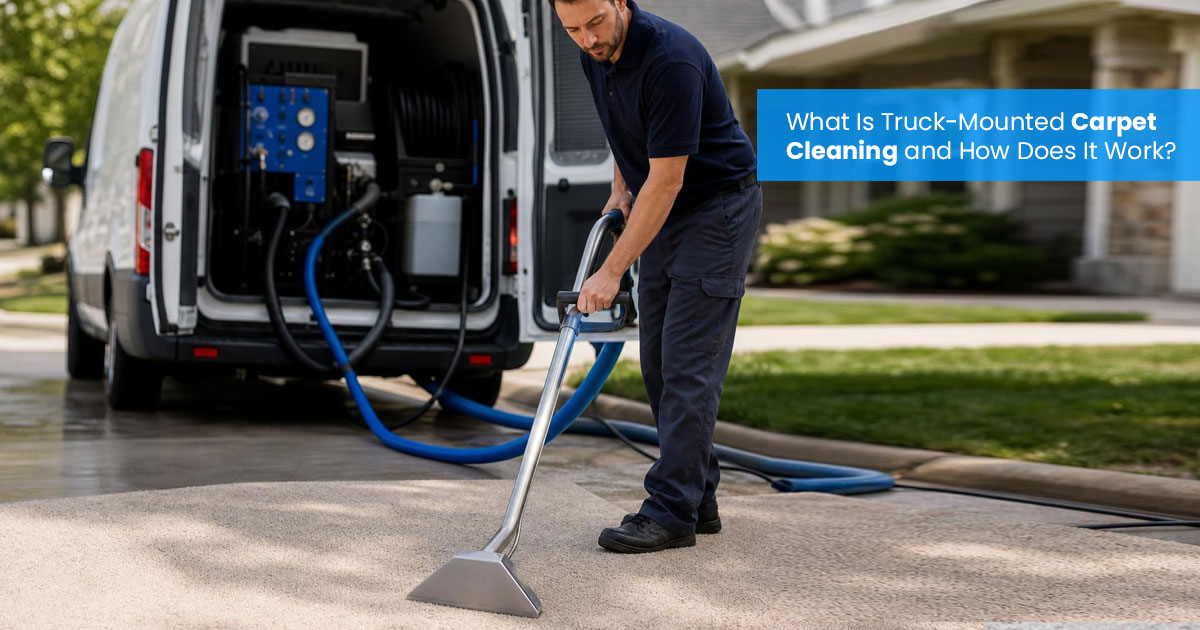
What Is Truck-Mounted Carpet Cleaning and How Does It Work?
TL;DR: Truck-mounted carpet cleaning is a professional hot water extraction method where a powerful cleaning system permanently installed inside a service vehicle heats water to 180–230°F, injects it into carpet fibres under high pressure, and vacuums out the dirty water simultaneously. It cleans faster, extracts more moisture, and dries in 4–6 hours compared to 8–24 hours with portable machines. For humid climates like the Gold Coast, that faster drying time is the difference between clean carpets and a mould problem.
Truck-mounted carpet cleaning is the most powerful form of professional carpet cleaning available to homeowners today. If you’ve ever seen a carpet cleaning van parked in a driveway with hoses running through the front door, you’ve seen a truck-mount system in action.
The concept is straightforward. A self-contained cleaning machine sits inside a van or truck. It uses the vehicle’s engine (or a dedicated auxiliary engine) to heat water, generate pressure, and power a vacuum. Hoses run from the vehicle into your home. Clean, heated solution goes in through one line, and dirty water comes back through another, collecting in an onboard waste tank. Nothing plugs into your home’s electrical outlets. Nothing drains into your plumbing.
The industry calls this process “hot water extraction,” and truck-mounted systems represent its most powerful version. If you want to understand how hot water extraction works in more detail, that guide covers the broader method. This article focuses specifically on what makes truck-mounted systems different, how the cleaning process works step by step, and when they’re the right choice.
Explore truck-mounted carpet cleaning on the Gold Coast →
How a Truck-Mounted Carpet Cleaning System Works
Understanding what is truck-mounted carpet cleaning and how does it work starts with the five core components inside the vehicle. Every truck-mount system, regardless of manufacturer, relies on these interconnected parts:
1. The engine. This powers the entire system. Some truck-mounts run off the vehicle’s own engine, while higher-end units have a separate dedicated engine. Either way, it generates the mechanical energy that drives everything else.
2. The heat exchanger. This is what gives truck-mounts their temperature advantage. The system captures heat from the engine’s exhaust and uses it to warm the cleaning solution. This approach heats water to 180–230°F, with some units reaching 240°F, without needing a separate boiler or your home’s hot water supply.
3. The water pump. This delivers fresh cleaning solution from the onboard tank (typically 50–120 gallons) through the hose and into the carpet. The large tank capacity means technicians can clean an entire house without needing to refill.
4. The pressure pump. This controls how forcefully the solution hits the carpet fibres. Truck-mounted units operate at 400–1,500 PSI, depending on the machine and the cleaning task. For standard carpet cleaning with a wand, most systems run at 400–500 PSI. Higher-quality units produce at least 900 PSI and 2.5 gallons per minute, generating enough power to operate hard surface cleaning tools as well.
5. The vacuum blower. This is arguably the most important component for homeowners. The blower creates powerful suction that pulls dirty water, loosened soil, allergens, and debris back through the return hose and into the waste tank. The vacuum power of a truck-mount far exceeds what any portable machine can generate from a household outlet.
These five systems work together in real time. While the technician is inside your home passing a wand across the carpet, the truck outside is simultaneously heating water, pressurising it, and vacuuming it back out. That’s why truck-mounted carpet cleaning produces results that a rental machine or portable unit simply cannot match.
The Truck-Mounted Cleaning Process: Step by Step
When a professional shows up with a truck-mounted system, the actual cleaning follows a specific sequence. Skipping steps or rushing through them produces noticeably worse results, so this is worth understanding if you want to evaluate your cleaner’s work.
Step 1: Pre-vacuuming
The technician dry-vacuums the carpet first to remove loose soil, pet hair, sand, and surface debris. This step matters more than most people realise. Skipping it forces the extraction system to work harder and reduces overall cleaning quality. Dry soil turns into mud when wet, and mud is harder to extract than dry particles.
Step 2: Pre-spray application
A chemical pre-spray is applied to heavily soiled areas and high-traffic lanes. The solution sits for several minutes (called “dwell time”) to break down grease, oils, body oils tracked from bare feet, and deeply embedded dirt. The chemistry is typically dosed at 2–4 ounces per gallon of water, adjusted for carpet type and soil level.
This precision matters. Over-dosing the pre-spray leaves sticky residue that attracts dirt faster after cleaning, making your carpets look dirty again within days. Under-dosing means the solution can’t break down embedded grime effectively. A skilled technician adjusts the concentration based on what they see.
Step 3: Water heating and pressurisation
Back at the truck, the engine fires up the heat exchanger and pump system. Water reaches operating temperature (180–230°F) and pressure (400–500 PSI for carpet). This happens quickly because the system is purpose-built for the task, unlike a portable machine that’s limited by whatever a household power point can supply.
Step 4: Hot water extraction
This is the main event. The technician passes a wand or rotary tool across the carpet in overlapping strokes. Heated solution injects into the fibres at high pressure while the vacuum simultaneously pulls dirty water back through the return hose. The simultaneous inject-and-extract action is what makes truck-mounted carpet cleaning so effective. You’re not soaking the carpet and then trying to suck it dry afterward. Both happen at once.
Step 5: Agitation
For particularly stubborn areas, the technician may use a rotary extraction tool or counter-rotating brushes to agitate the carpet fibres. This mechanical action breaks up dirt and stains that hot water alone might not fully release. It’s especially useful on pet stains, which can penetrate deep into carpet backing and padding. If pet odour is your primary concern, this guide on removing pet urine odour covers the topic in depth.
Step 6: Waste recovery
All recovered dirty water stays in the onboard waste tank. Nothing drains into your yard, storm drains, or household plumbing. A responsible technician disposes of this wastewater properly off-site. This is both an environmental consideration and a practical one, since the waste water from a heavily soiled carpet can contain bacteria, chemicals, and allergens you don’t want near your property.
Step 7: Optional post-cleaning grooming
Some technicians finish by grooming the carpet pile with a carpet rake or applying a light deodoriser. Grooming helps the fibres stand upright as they dry, which improves appearance and speeds airflow across the carpet surface.
Why Truck-Mounted Carpet Cleaning Matters
Now that you understand the mechanics, here’s why the method produces genuinely better outcomes than the alternatives.
Deeper extraction
A truck-mount’s vacuum blower generates significantly more suction than any portable machine. Where a standard portable might struggle to pull embedded pet hair, sand, or allergens from deep in the carpet pile, a truck-mount extracts them with ease. The carpet isn’t just visually cleaner. It’s physically cleaner at the fibre level.
Practitioners on professional cleaning forums consistently reinforce this point. One veteran operator on Mikey’s Board (a well-known carpet cleaning industry forum) shared: “I started with a portable thinking that I could build a business with that… I was going nowhere and spent way too much time on all my jobs. Then I got a truckmount. The customers that you want, the ones that are willing to pay, get their carpets cleaned often and refer you to other like-minded people… they EXPECT a truck mount.”
Higher water temperatures kill bacteria
The World Health Organization states that temperatures of 140–150°F are sufficient to kill most viruses and bacteria. Truck-mounted systems routinely operate at 180–230°F, well above that threshold. A 2017 study by the Carpet and Rug Institute found that hot water extraction can reduce bacteria levels by up to 99%.
This matters for households with young children, allergy sufferers, or anyone concerned about indoor air quality. To understand the broader benefits of carpet cleaning beyond stain removal, including allergen reduction and air quality improvement, that resource breaks it down.
No reliance on your home’s power
The entire system runs from the vehicle. Residential outlets in Australia cap at 240 volts, which severely limits what a portable machine can achieve in terms of heat and vacuum power. A truck-mount bypasses this limitation entirely. It generates its own power, heats its own water, and carries its own supply. Your home just provides access.
Carpet warranty compliance
This is a point many homeowners overlook. Major carpet manufacturers, including Mohawk, Shaw, and Beaulieu, require professional hot water extraction cleaning every 12–18 months to keep warranties valid. Mohawk specifically requires professional hot water extraction using products and equipment that carry the CRI Seal of Approval. A carpet industry practitioner on Mikey’s Board confirmed that “most flooring manufacturers require ‘hot water extraction’ at least once every 18 months or it voids any warranties.”
Bonnet cleaning, dry cleaning, and DIY rental machines typically do not satisfy these warranty requirements. If you’ve spent thousands on new carpet, truck-mounted hot water extraction is the method that protects your investment. This is particularly relevant for end-of-lease carpet cleaning situations where proof of professional cleaning is required.
Truck-Mounted vs. Portable: When Each Makes Sense
Every searcher asking what is truck-mounted carpet cleaning and how does it work is implicitly comparing it to the alternatives. Here’s an honest breakdown.
|
Metric |
Truck-Mounted |
Portable |
|---|---|---|
|
Water temperature |
180–230°F (up to 240°F) |
122–150°F |
|
Water pressure |
400–1,500 PSI |
50–500 PSI |
|
Drying time |
4–6 hours |
8–24 hours |
|
Cleaning speed (3-bedroom house) |
90–120 minutes |
2.5–4 hours |
|
Power source |
Vehicle engine |
Home electrical outlet |
|
Best suited for |
Houses, ground-floor commercial |
High-rises, restricted access areas |
The numbers make a clear case for truck-mounted systems in most residential scenarios. Faster cleaning, hotter water, more pressure, and dramatically shorter drying times.
But portables have their place. For high-rise apartments above the third or fourth floor, a portable is often the only practical option. Truck-mounted hoses typically reach 100–200 feet effectively, and performance drops noticeably past 150 feet. On a 20th-floor apartment, the hose would need to travel from the parking area, through the lobby, up the elevator shaft or stairwell, and down the hallway. That’s often 300+ feet, well beyond what the system can handle while maintaining pressure and heat.
One technician on a professional forum put it bluntly: “A crappy TM at 150 feet probably isn’t as good as a great portable at 15 feet.” The takeaway is that equipment quality and technician skill matter as much as equipment type. A well-maintained, high-quality portable operated by a skilled technician will outperform a neglected truck-mount operated by someone cutting corners.
For a more detailed comparison specific to larger homes, this truck-mounted vs. portable guide covers the differences worth considering.
Why Drying Time Matters on the Gold Coast
This is where the truck-mounted vs. portable comparison becomes more than academic for Gold Coast homeowners.
The Gold Coast’s subtropical climate means humidity sits between 60% and 80% year-round. During summer, it regularly pushes higher. Mould can begin growing within 24–48 hours of sustained moisture exposure. That timeline creates a direct connection between your carpet cleaner’s equipment and your home’s health.
A truck-mounted system that gets carpets dry in 4–6 hours keeps you well within the safe window. Practitioners report that truck-mounted systems remove roughly 40% more moisture per pass than portable machines, which directly translates to faster drying. A portable machine pushing drying time to 12–24 hours, especially during a Gold Coast summer, creates real mould risk.
This isn’t a theoretical concern. It’s the practical reality of cleaning carpets in a humid climate. If you’re weighing whether the method is worth the investment on the Gold Coast, drying time is the single biggest factor to consider.
The same truck-mount systems that clean carpets can also power tile and grout cleaning tools when operating at higher PSI settings, making it possible to handle multiple surfaces in a single visit.
Honest Limitations of Truck-Mounted Cleaning
No cleaning method is perfect for every situation. Here are the real constraints.
Hose reach. Truck-mounted hoses effectively operate within 100–200 feet of the vehicle. According to industry sources, hoses start losing pressure once they reach 150 feet. Anything above the third floor of a building typically won’t be cleaned as well, if it’s reachable at all.
Parking access. The truck needs to park reasonably close to your building’s entry point. Narrow driveways, gated communities with restricted parking, or buildings with no adjacent street parking can all complicate setup.
Engine noise. The vehicle engine runs continuously during the cleaning process. It’s not excessively loud, but it’s noticeable. For noise-sensitive environments (apartments with thin walls, sleeping babies next door, or late-evening appointments), this is worth considering.
Technician skill still matters. A truck-mounted system in the hands of an undertrained technician can damage carpet fibres through excessive heat or leave residue from improper chemical dosing. Wool carpets, for instance, require different chemistry and lower heat settings than synthetic nylon or polyester. The machine doesn’t make those decisions. The operator does.
Cost. Truck-mounted cleaning costs more than DIY rental machines or budget operators using portables. The equipment alone costs $8,000–$45,000, and that investment is reflected in service pricing. But for most homeowners, the deeper clean, faster drying, and warranty compliance justify the difference.
What to Look for in a Truck-Mounted Carpet Cleaning Provider
Understanding what truck-mounted carpet cleaning is and how it works puts you in a strong position to evaluate providers. Here are five specific questions worth asking before you book.
Do they pre-vacuum and pre-spray? If a technician skips straight to extraction, they’re cutting corners. Pre-vacuuming and pre-spraying are essential preparation steps that directly affect cleaning quality.
What temperature and pressure do they run? You should get a specific answer. Vague responses like “really hot” or “high pressure” suggest the operator either doesn’t know their equipment or doesn’t want to commit to a number. Expect to hear something in the 180–220°F and 400–500 PSI range for carpet.
Do they adjust chemistry by carpet fibre type? Wool, nylon, polyester, and olefin all respond differently to heat and chemicals. A one-size-fits-all approach risks damage or poor results.
What’s the expected drying time? For a standard home, 4–6 hours is reasonable. If they’re quoting 12+ hours, they may be using a lower-powered system or over-wetting the carpet.
Can they provide proof of equipment? A legitimate truck-mount operator will happily show you the machine in the vehicle. Some providers will even arrange a demonstration before you commit to a full-house clean.
For a broader framework on evaluating providers, this guide to choosing a deep carpet cleaning company covers additional criteria worth reviewing.
Frequently Asked Questions
Is truck-mounted cleaning the same as steam cleaning?
The terms are used interchangeably in everyday conversation, but they’re technically different. “Steam cleaning” is the common name; “hot water extraction” is the industry term. Truck-mounted cleaning is the most powerful form of hot water extraction. The system doesn’t actually produce steam in the scientific sense. It uses very hot water (180–230°F) injected under pressure, not true vapour at 212°F+.
How long does it take for carpets to dry after truck-mounted cleaning?
Typically 4–6 hours. This compares favourably to 8–24 hours with portable machines. Airflow helps, so opening windows or running fans and air conditioning will speed things up. On the Gold Coast, running air con during the drying period is especially helpful given the high ambient humidity.
Can truck-mounted cleaning be used in apartments?
It depends on the floor level and building access. Ground-floor and first-floor apartments are usually fine. Above the third floor, hose length and pressure loss become real issues. Most professional operators recommend portable units for high-rise buildings where the truck can’t park within 150 feet of the apartment.
Does truck-mounted cleaning void my carpet warranty?
The opposite. Most major carpet manufacturers, including Mohawk, Shaw, and Beaulieu, specifically require professional hot water extraction (the method truck-mounts use) every 12–18 months to maintain warranty coverage. DIY rental machines and dry cleaning methods often do not satisfy these requirements.
How often should I get truck-mounted carpet cleaning done?
Every 12–18 months for warranty compliance. Households with pets, children, allergy sufferers, or heavy foot traffic may benefit from cleaning every 6–12 months. Regular vacuuming between professional cleans extends the results.
Is truck-mounted cleaning safe for wool carpets?
Yes, but it requires a skilled technician. Wool is more sensitive to heat and alkaline chemicals than synthetic fibres. A competent operator will lower the water temperature, reduce pressure, and use a wool-safe, pH-neutral cleaning solution. Always confirm that your technician has experience with wool before the job starts.
How much water does a truck-mounted system use?
The fresh water tank holds 50–120 gallons depending on the vehicle. For a standard 3-bedroom house, a single tank fill is usually sufficient. The powerful extraction means most of that water gets pulled back out of the carpet, which is why drying times are so much shorter than with portable machines.