
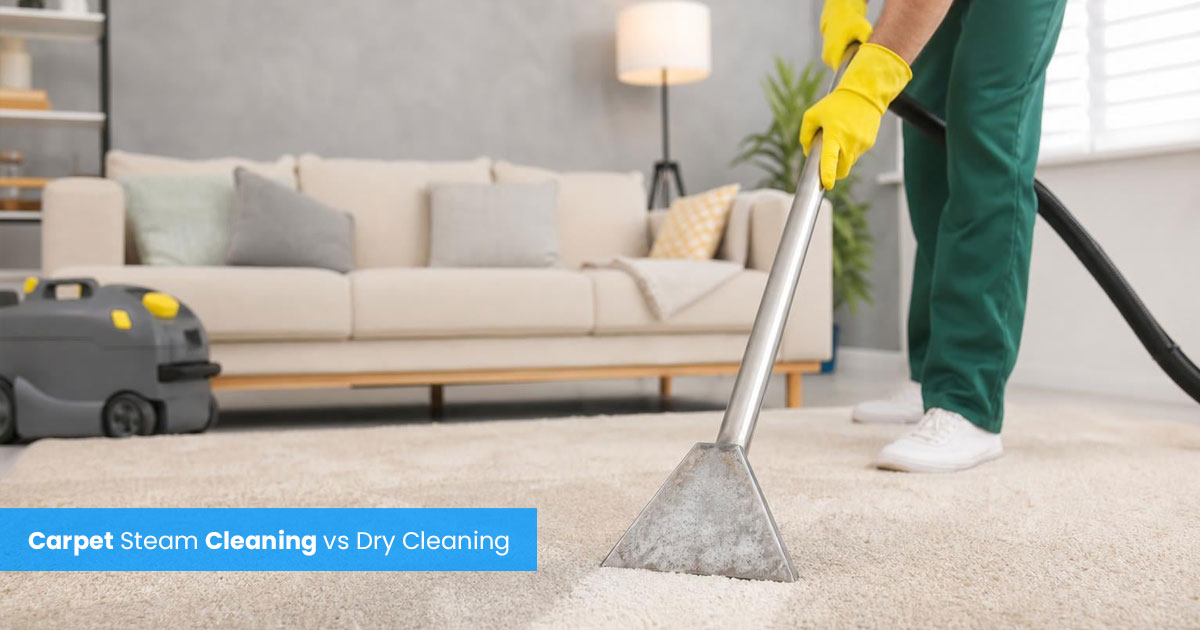
Carpet Steam Cleaning vs Dry Cleaning: Expert 2026 Guide
TL;DR
Steam cleaning (hot water extraction) is the deep cleaning method recommended by carpet manufacturers and the IICRC, capable of killing up to 99.99% of bacteria and reaching dirt embedded in the carpet backing. Dry cleaning uses chemical compounds with minimal moisture, dries in under two hours, and works well as a maintenance clean between annual steam cleans. Using only dry cleaning methods can void your carpet warranty from major brands like Shaw and Mohawk. For Gold Coast homes, truck-mounted steam cleaning equipment provides the strongest extraction, which matters in subtropical humidity.
Looking for professional carpet steam cleaning on the Gold Coast? Get a carpet cleaning quote with no hidden fees.
What Is Carpet Steam Cleaning?
Despite the name, carpet steam cleaning doesn’t actually use steam. The industry term is hot water extraction (HWE). A cleaning solution and hot water, typically heated above 200°F (93°C), are injected into the carpet under high pressure. Powerful suction then extracts the water along with dissolved dirt, allergens, bacteria and stains from deep within the carpet fibres.
The result is a flush-and-extract process that reaches all the way down to the carpet backing and pad, something no surface cleaning method can achieve.
How the Process Works
- The carpet is pre-vacuumed to remove loose debris.
- A pre-treatment solution is sprayed onto stains and high-traffic areas.
- Hot water and cleaning solution are injected into the carpet at high pressure.
- A powerful vacuum immediately extracts the dirty water, pulling contaminants out of the fibres.
- The carpet is left damp (not soaking) and dries over the following hours.
Truck-Mounted vs Portable Equipment
Not all steam cleaning equipment performs equally. Truck-mounted machines generate significantly more heat, water pressure and suction than portable units. That stronger extraction pulls more moisture out of the carpet, which means faster drying and deeper cleaning.
As one professional carpet cleaner noted on a popular home improvement forum, DIY rental machines “don’t even come close to the heat and suction generated by professional equipment, and therefore the cleaning is superficial at best.” For lightly soiled carpet they might manage, but on dirty carpets they fall short. You can read more about how truck-mounted systems work and why they matter.
What Is Carpet Dry Cleaning?
Carpet dry cleaning uses chemical powders or solvents with very little water. A cleaning compound is spread across the carpet, worked into the fibres with a rotary brush machine, and then vacuumed away along with the loosened soil. The term “dry” is a bit misleading, as some moisture is still involved, but far less than hot water extraction.
Drying time is the main selling point. Carpets are typically ready to walk on within 30 minutes to two hours, compared to several hours for steam cleaning.
What About Encapsulation?
Encapsulation is a specific type of low-moisture cleaning that often gets lumped under the “dry cleaning” label. A dry solvent is agitated into the carpet fibres, where it surrounds dirt particles and crystallises. Once dry, the crystals are vacuumed away.
It was originally developed for commercial glue-down loop-pile carpet tiles and works well in that context. However, the IICRC and major encapsulation product manufacturers recommend at least one full hot water extraction for every three to four encapsulation cleans to flush out accumulated polymer residue and deep-seated soil.
This is an important detail. Encapsulation is a complement to steam cleaning, not a substitute for it.
Key Differences at a Glance
|
Factor |
Steam Cleaning (HWE) |
Dry Cleaning |
|---|---|---|
|
How it works |
Hot water + solution injected, then extracted with suction |
Chemical compound brushed into fibres, then vacuumed |
|
Cleaning depth |
Deep, reaches carpet backing and pad |
Surface to mid-pile only |
|
Bacteria removal |
Up to 99.99% |
Limited, relies on chemical action |
|
Drying time |
6 to 12 hours (professional); up to 24 hours for wool or humid conditions |
30 minutes to 2 hours |
|
Stain removal |
Excellent for set-in stains, pet urine, odours |
Better for surface and oily stains |
|
Chemical residue |
Minimal (water-based) |
Can leave powder or chemical residue over time |
|
Carpet warranty |
Required by Shaw, Mohawk, Beaulieu |
Does not meet warranty requirements alone |
|
Best for |
Annual deep clean, allergen removal, pet households, bond cleans |
Interim maintenance, fast turnaround, delicate natural fibres |
|
Equipment |
Truck-mounted or professional portable units |
Rotary brush machine + vacuum |
|
Cost (AU professional) |
Slightly higher |
Slightly lower |
When comparing carpet steam cleaning vs dry cleaning, the table makes one thing clear: they serve different purposes. Steam cleaning is the reset. Dry cleaning is the top-up.
Which Method Do Carpet Manufacturers Require?
This is the part most comparison articles skip, and it might be the most important factor in the carpet steam cleaning vs dry cleaning decision.
Shaw Industries, one of the world’s largest carpet manufacturers, requires homeowners to show proof of periodic cleaning by hot water extraction to maintain warranty coverage. Their warranty explicitly does not cover cleaning by “rotary machines, dry steam, and other processes not approved by the CRI and IICRC.”
Mohawk has similar requirements. Their warranty mandates professional hot water cleaning every 18 months using equipment or systems that carry the Carpet Rug Institute (CRI) Seal of Approval.
Both Shaw and Mohawk require documented hot water extraction cleaning every 12 to 18 months. Missing that documentation voids most warranty claims.
The Environmental Protection Agency, IICRC, Carpet Rug Institute and carpet manufacturers all recommend hot water extraction every 6 to 12 months for health reasons.
What this means for you: If your carpet is still under warranty and you’ve only been using dry cleaning methods, you may have already voided your coverage without realising it. This applies whether you bought premium Mohawk or Shaw carpet, or any brand with similar warranty language. Understanding the broader benefits of professional carpet cleaning can help you protect both your investment and your warranty.
When to Choose Steam Cleaning
Steam cleaning is the right choice when you need a genuine deep clean. Here are the situations where it’s the clear winner in the carpet steam cleaning vs dry cleaning comparison.
Annual or bi-annual deep clean. Even well-maintained carpets accumulate grit, body oils, skin cells and allergens deep in the fibres. Hot water extraction flushes these out in a way surface cleaning simply cannot.
Pet urine and odour removal. Urine soaks through the carpet fibres into the backing and sometimes the underlay. No amount of dry compound will reach it. Steam cleaning with pre-treatment is the standard professional approach for removing cat urine smell from carpet and other pet odour problems.
Allergen and dust mite removal. Studies show steam cleaning eliminates up to 99.99% of bacteria. The high water temperature kills dust mites, and the extraction removes their waste products, which are the actual allergen trigger.
End-of-lease and bond cleans. Most property managers and real estate agents expect professional steam cleaning as part of a bond clean. A dry cleaning receipt often won’t satisfy the requirement.
If you’re preparing for an inspection, it’s worth reading about end-of-lease carpet cleaning and what property managers actually look for.
Warranty maintenance. As outlined above, regular hot water extraction is the only cleaning method that keeps your manufacturer’s warranty valid.
When to Choose Dry Cleaning
Dry cleaning has a legitimate place in carpet care. Dismissing it entirely would be dishonest.
Interim maintenance between deep cleans. If you had your carpets steam cleaned six months ago and they’re looking a bit tired in the hallway, a dry clean or encapsulation can freshen things up without the drying time.
Delicate natural fibre carpets. Silk rugs and certain wool carpets don’t respond well to hot water extraction. Wool is extremely absorbent, and 100% wool carpets can take up to 24 hours to dry after steam cleaning. For these fibres, a low-moisture method reduces the risk of shrinkage or damage.
Fast turnaround situations. Commercial spaces, offices preparing for events, or households that cannot have rooms out of service for half a day will benefit from 30-minute to 2-hour drying times.
Humid climate timing. During the Gold Coast’s most humid months, some homeowners prefer a quick dry clean rather than dealing with extended drying times. This is a practical choice, though it should complement rather than replace a regular steam clean.
Drying Time: What to Expect on the Gold Coast
Drying time is the biggest practical difference between carpet steam cleaning vs dry cleaning, and Gold Coast residents feel this more than most Australians.
The Gold Coast’s subtropical climate brings average humidity levels of 60% to 70% or higher in summer. Since carpet drying depends on evaporation, that humidity directly slows the process. Even when the cleaning is performed perfectly, humid air simply absorbs less moisture.
Typical drying times:
- Steam cleaning (professional, truck-mounted): 6 to 12 hours. Thick carpet or high humidity can push this to 24 hours.
- Dry cleaning: 30 minutes to 2 hours.
Tips to Speed Up Drying After Steam Cleaning
- Turn on air conditioning. It reduces indoor humidity and circulates air.
- Run ceiling fans in every cleaned room.
- Open windows in the morning when outdoor humidity is lower (avoid late-afternoon tropical air).
- Schedule your clean for early morning so the carpet has the full day to dry.
- Choose truck-mounted equipment over portable units. The stronger extraction leaves less moisture behind, which makes a meaningful difference in humid conditions. This is one reason truck-mounted cleaning is worth considering on the Gold Coast specifically.
Carpet fibre type also matters. Synthetic carpets (nylon, polyester) release moisture faster and are well suited to steam cleaning. Wool carpets hold more water and dry more slowly.
Common Misconceptions
“Steam cleaning shrinks carpets”
This only happens when incorrect equipment or technique is used, particularly when cheap machines over-wet the carpet without adequate extraction. Professional truck-mounted systems control water flow precisely and extract the majority of moisture.
“Dry cleaning is chemical-free”
It’s not. Dry cleaning compounds are chemicals. They’re designed to attract and encapsulate dirt, but they leave residue. Based on survey data from 67,100 Angi customers, dry cleaning is less preferred partly because it relies on chemicals and perfumes that can leave residue damaging carpet fibres over time. Steam cleaning, which is primarily water-based, is actually the more eco-friendly option.
“Steam cleaning causes mould”
Only if the carpet is over-wet and left without proper ventilation. Professional equipment extracts enough water that the carpet is damp, not saturated. In properly ventilated rooms, even in Gold Coast humidity, mould from a professional steam clean is extremely unlikely.
What Is “Wicking” and Should You Worry About It?
Wicking is when stains reappear on the carpet surface days after cleaning. A ChemDry franchise owner on Houzz acknowledged that wicking “is a problem mostly associated with the steam cleaning process” when excessive moisture is left behind. However, other forum participants countered that ChemDry’s own method is “often accused of fear marketing” and “doesn’t really extract the dirt from the carpet.”
The truth sits in the middle. Wicking happens when too much moisture remains in the carpet, allowing dissolved stains to wick back up the fibres as the carpet dries. Professional truck-mounted equipment with high suction power minimises this risk significantly. DIY rental machines, with their weaker extraction, are far more likely to cause wicking. For a more complete look at how truck-mounted systems compare to portable units, see this side-by-side breakdown.
The Expert Approach: Combining Both Methods
The carpet cleaning industry has largely settled the carpet steam cleaning vs dry cleaning debate. The answer isn’t one or the other. It’s both, used strategically.
Most professionals recommend hot water extraction once or twice per year as the deep clean that flushes accumulated soil, allergens and residue. Between those deep cleans, dry cleaning or encapsulation can handle surface freshening in high-traffic areas.
In commercial settings, this combined approach is standard practice. Hot water extraction is used periodically to reset the carpet, followed by encapsulation for routine maintenance. The same principle works at home.
Based on Angi’s survey of over 67,000 customers, steam cleaning is the most popular carpet cleaning method, chosen by 46.5% of homeowners. That popularity reflects both its effectiveness and the fact that it’s the method recommended by manufacturers and industry bodies.
The key is not to rely on dry cleaning alone. Do that, and you risk voided warranties, accumulated chemical residue, and dirt that never gets properly removed from the carpet base.
Ready to book a deep clean? Explore carpet cleaning services on the Gold Coast with transparent pricing and truck-mounted equipment.
Frequently Asked Questions
Is steam cleaning or dry cleaning better for carpets?
Steam cleaning (hot water extraction) is better for deep cleaning and is the method recommended by carpet manufacturers, the IICRC, and the Carpet Rug Institute. Dry cleaning is useful for quick maintenance between deep cleans but doesn’t reach embedded dirt or meet warranty requirements on its own.
Will dry cleaning void my carpet warranty?
It can. Major manufacturers like Shaw and Mohawk require documented hot water extraction cleaning every 12 to 18 months. Shaw’s warranty explicitly excludes cleaning by rotary machines and dry methods not approved by the CRI and IICRC. If you’ve only been dry cleaning, your warranty may already be void.
How long does carpet take to dry after steam cleaning on the Gold Coast?
Professional truck-mounted steam cleaning typically leaves carpets dry within 6 to 12 hours. On the Gold Coast, summer humidity can extend this. Running air conditioning, ceiling fans and scheduling morning cleans all help. Wool carpets take longer than synthetics.
Does steam cleaning remove pet urine smell?
Yes. Hot water extraction is the recommended method for pet urine because it reaches the carpet backing and underlay where urine soaks in. Dry cleaning only treats the surface and won’t address odour at its source. For detailed guidance, see this urine odour removal guide.
Is dry carpet cleaning really “dry”?
Not completely. Dry cleaning methods still use some moisture, just far less than steam cleaning. The term refers to the minimal water involvement, not the total absence of liquid.
Can I alternate between steam and dry cleaning?
Yes, and this is actually what the industry recommends. A common professional maintenance schedule is one hot water extraction for every three to four encapsulation or dry cleans. This ensures deep soil gets flushed out regularly while keeping carpets fresh between appointments.
Does steam cleaning kill dust mites and bacteria?
Steam cleaning at temperatures above 200°F kills dust mites, mould spores and bacteria on contact. Studies indicate it can eliminate up to 99.99% of bacteria, making it the preferred method for allergy sufferers and households with young children.
Which method is better for end-of-lease bond cleaning?
Steam cleaning. Most property managers and agents require a professional steam cleaning receipt as part of the bond clean process. A dry cleaning receipt may not be accepted. If you’re approaching a lease end, start by reviewing how to prepare for a carpet inspection.