
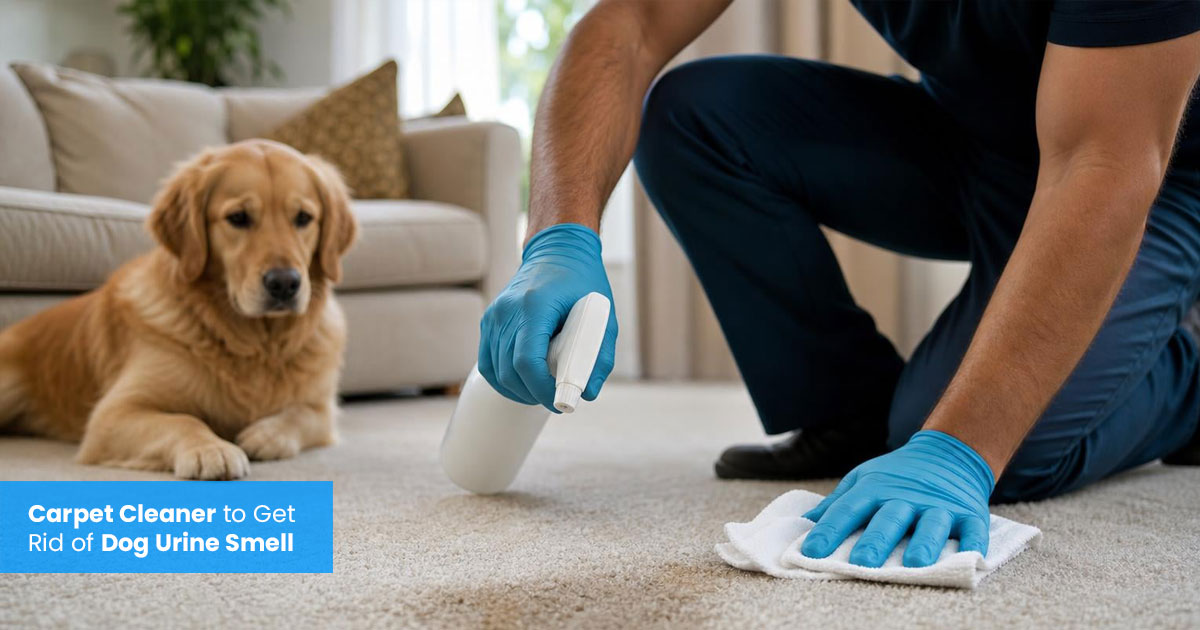
Carpet Cleaner to Get Rid of Dog Urine Smell: 2026 Guide
TLDR
The best carpet cleaner to get rid of dog urine smell depends on how deep the urine has soaked. Fresh accidents on the surface usually respond to blotting and an enzyme cleaner. Old or repeated urine often reaches carpet backing, underlay, or subfloor, where surface sprays and portable machines cannot reach it. When the smell keeps returning after cleaning, professional extraction or underlay replacement is usually what is needed.
Nearly half of all Australian households have at least one dog, according to Animal Medicines Australia’s 2025 survey. Dog urine on carpet is not a rare disaster. It is one of the most common household cleaning problems in the country.
The challenge is that most people reach for the wrong type of carpet cleaner to get rid of dog urine smell, or they use the right product the wrong way. The smell lingers, returns after cleaning, or gets worse when the carpet gets wet again. The core issue is depth. A cleaner that only treats the surface will not fix a smell that lives in the underlay.
This guide covers what “carpet cleaner for dog urine smell” actually means, which products and methods work at each stage, why the smell comes back, and when professional help becomes the only practical answer.
If the smell has already survived your DIY attempts, professional carpet steam cleaning with truck-mounted equipment provides deeper extraction than portable machines.
What “Carpet Cleaner to Get Rid of Dog Urine Smell” Actually Means
The phrase “carpet cleaner” is ambiguous. It can refer to three different things, and the right one depends on how far the urine has travelled.
A product. Enzyme cleaners, oxidising sprays, pet stain removers, carpet shampoo solutions. This is what most people try first.
A machine. Portable carpet extractors, rented shampooers, wet/dry vacuums, and home carpet cleaning machines.
A professional process. A trained technician using inspection, pre-treatment, flushing, extraction, and drying, often with truck-mounted equipment that generates far more suction and water pressure than any rental unit.
The most effective carpet cleaner for dog urine smell is whichever one actually reaches the urine. That sounds obvious, but it is the point most people miss. Whole Dog Journal states it clearly: apply enough cleaner to penetrate as deeply as the urine did, because urine can soak through carpet, underlayers, and even subflooring. A light spray on top of a deep problem will not work.
Why Dog Urine Smell Stays in Carpet
Dog urine is not just a liquid stain. It contains bacteria that produce ammonia-like odours as the urine breaks down, plus pheromones that act as scent markers. PetMD explains that these pheromones can draw a dog back to the same spot, creating a cycle of repeat urination.
Once urine dries, it forms uric acid crystals and salts that bond to carpet fibres. These crystals are not easily dissolved by water alone, which is why regular carpet shampoo often fails. Worse, urine spreads wider beneath the surface than the visible wet spot suggests. Practitioners on carpet-cleaning forums note that a small visible stain can be much larger underneath once urine has penetrated through the carpet, cushion, and subfloor.
For a deeper look at why urine odour persists across different scenarios, see our full urine smell removal guide.
Dried urine also becomes more alkaline over time. In humid climates like the Gold Coast, moisture in the air can reactivate those residues. The Carpet and Rug Institute warns that odour can reappear in high humidity if urine is not completely removed from deeper layers.
The 4-Layer Urine Smell Map
Most carpet cleaning advice treats dog urine as a one-dimensional surface problem: spray, scrub, done. In reality, urine can sit at four different depths, and each one demands a different approach.
Layer 1: Carpet Face Fibres
Fresh urine sits on the visible pile first. If you catch it within minutes, blotting and an enzyme cleaner will usually handle it. This is the easiest layer to clean and the one where DIY methods work best.
Layer 2: Carpet Backing
Urine spreads sideways and downward through the carpet backing. The contaminated area beneath the surface is often wider than the visible stain on top. Cleaning the pile alone leaves odour-causing residues trapped in the backing. More product volume, longer dwell time, and proper extraction become important at this layer.
Layer 3: Underlay (Padding)
This is where most DIY carpet cleaners fail. Underlay is absorbent. It soaks up urine like a sponge and holds it. A portable carpet cleaner or rented machine may improve the surface appearance while the underlay stays saturated underneath. One user on an Australian Whirlpool forum described using a household shampooer, pet smell spray, and a professional clean, but still smelling urine close to the carpet. Other commenters suggested peeling back the carpet and replacing affected underlay.
Layer 4: Subfloor
In severe cases (repeated accidents in the same spot, elderly or incontinent dogs, hidden puddles behind furniture), urine reaches timber floorboards, concrete, tack strips, or skirting boards. Carpet cleaning alone cannot solve a subfloor problem. The subfloor itself may need treatment, sealing, or replacement.
Best Types of Carpet Cleaner for Dog Urine Smell
Enzyme Cleaners
Enzyme cleaners are the best DIY carpet cleaner for dog urine smell in most fresh or moderate cases. They contain proteins that break down uric acid and other organic residues rather than covering the smell with fragrance. Whole Dog Journal recommends checking product labels, testing in a hidden area, and using enough product for the size and age of the stain.
The most common mistake is undersaturation. Practitioners on Reddit’s r/CleaningTips repeatedly emphasise that enzyme solution needs to reach the contaminated layer, not just dampen the carpet surface. Some users recommend covering the treated area with plastic to slow evaporation and allow enough dwell time. Results become inconsistent, though, when urine has already soaked into padding or subfloor.
Oxidising Cleaners
Products based on hydrogen peroxide can help with both staining and residual odour. However, they carry more risk than enzyme cleaners. The IICRC cautions that hydrogen peroxide is not recommended for wool or other natural fibres without extensive testing. Always spot-test first, and avoid oxidising cleaners on wool carpet without professional guidance.
Baking Soda and Vinegar
These are popular household remedies with real but limited usefulness. Baking soda absorbs some surface moisture and odour. A dilute vinegar solution can help with mild fresh odour. But vinegar masks smell while enzymes break down the source. For deep or old dog urine, baking soda and vinegar are first aid, not a cure.
Portable Carpet Cleaners and Wet/Dry Vacuums
A wet/dry vacuum is genuinely useful for extracting fresh urine right after blotting. Portable carpet cleaners and rented machines can rinse and extract surface-level contamination.
The limitation is reach. These machines do not generate the suction or water pressure needed to flush urine from underlay. If the smell came back after using a portable machine, that is a strong sign the urine went deeper than the machine could go. For a comparison of what different equipment actually delivers, see truck-mounted vs portable extraction.
Professional Hot Water Extraction
Professional carpet cleaning with truck-mounted equipment provides higher water temperature, greater suction, and more thorough extraction than consumer machines. When combined with urine-specific pre-treatment, it is the strongest option for embedded dog urine smell.
One critical caution: do not use heat on untreated dried urine as your first step. The AKC warns that heat can set dried urine stain and odour permanently if the urine has not been pre-treated. This does not mean professional hot water extraction is bad. It means the order matters: treat the urine first, then extract.
To understand what makes professional extraction different from a rental machine, see our guide on hot water extraction benefits.
Underlay Replacement
When urine has saturated the underlay or subfloor, no amount of surface cleaning will permanently remove the smell. In severe cases, the most practical option is to pull back the carpet, replace the affected underlay, treat the subfloor if needed, and relay the carpet. This is more invasive and costly, but it addresses the actual source.
A carpet-cleaning practitioner on LinkedIn described a severe pet urine job where the company recommended replacement because urine had penetrated through carpet into padding and subfloor. The client chose cleaning instead, and the company used sub-surface extraction to flush contamination from deep within. In many severe cases, replacement would have been the more reliable outcome.
What to Do When Dog Urine Is Fresh
Speed matters. The faster you act, the less urine soaks into lower layers.
- Blot immediately with white towels or paper towels. Press firmly. Do not rub, because rubbing pushes urine deeper and spreads it wider.
- Rinse lightly with cool water. Not hot. Heat can set urine proteins.
- Extract moisture with a wet/dry vacuum if you have one.
- Apply enzyme cleaner following label directions. Use enough to match the stain’s footprint and let it sit for the recommended dwell time.
- Keep pets away until the area is completely dry.
- Dry quickly with fans, airflow, or open windows. Slow drying encourages bacterial growth and secondary odour.
Dog urine does not only end up on carpet. For stains on fabric furniture, sofas, or armchairs, the process is similar but the materials differ. See our guide on pet urine smell on couches.
Why Your Carpet Still Smells After Cleaning
This is the question that fills Reddit threads and cleaning forums. Someone cleans the carpet, it looks and smells fine for a day, and then the dog urine smell returns. Sometimes it smells worse. Here is why.
Urine reached the underlay. The carpet surface is clean, but the smell source sits underneath. Multiple users on Reddit’s r/CarpetCleaning describe trying portable machines, vinegar, baking soda, and enzyme sprays, only to find the odour returns once everything dries.
Cleaning rehydrated old residues. Adding water or cleaning solution to carpet can reactivate dried uric acid crystals and bacteria in the backing or underlay. The smell may seem worse because dormant residues are suddenly releasing odour again.
Heat was applied to untreated urine. If a steam cleaner or hot water was used before the urine was treated, the heat may have bonded the stain and odour more permanently to the fibres.
Too much product, not enough extraction. Pouring cleaner onto carpet without extracting it properly leaves a wet mess that dries slowly. Slow drying creates conditions for bacterial growth and a new layer of bad smell on top of the old one.
Humidity. On the Gold Coast and across Southeast Queensland, humidity is high enough that urine residues in deeper carpet layers can reactivate on warm, muggy days. If the carpet smells fine with the air conditioning running but terrible on a humid evening, residues in the backing or underlay are almost certainly the cause.
When DIY Carpet Cleaner Is Not Enough
Not every dog urine problem can be solved with a spray bottle and a rental machine. Consider professional carpet cleaning if:
- The dog used the same spot more than once
- The room smells even though the carpet looks clean
- The smell gets stronger after machine cleaning or on humid days
- The carpet stays damp too long after cleaning
- You can smell urine near skirting boards or walls
- It is an end-of-lease or bond situation with a deadline
- You suspect urine reached the underlay or subfloor
- Previous DIY products and methods have not worked
Professional equipment can assess the damage, treat the urine before extraction, and provide the kind of deep flush that consumer machines cannot replicate.
What Professional Dog Urine Treatment Involves
A professional carpet cleaner for dog urine smell should follow a proper sequence, not simply run a machine over the surface.
- Identify affected areas. This may involve asking where accidents happened, visual inspection, and sometimes UV (black light) detection. The IICRC notes that UV light helps locate urine that is invisible under normal lighting.
- Pre-treat urine areas. Apply a urine-specific treatment (enzyme, oxidiser, or proprietary solution) before any extraction.
- Flush and extract. Use high-powered extraction to remove contamination from fibres and, where possible, from the backing.
- Assess deeper layers. Determine whether the underlay or subfloor needs attention beyond surface cleaning.
- Speed dry. Proper airflow and ventilation reduce the chance of secondary odour from slow drying.
- Set realistic expectations. An honest professional will explain upfront whether full odour removal is realistic or whether underlay work is needed.
One nuance worth knowing: a UV light can still show fluorescence after professional cleaning. This does not necessarily mean the cleaning failed. IICRC explains that phosphorus from urine breakdown can become chemically bonded to fibres, causing post-clean glow even when the odour source has been addressed.
Not every urine stain can be fully restored. The Carpet and Rug Institute states that some stains may not be removable because success depends on urine composition, carpet dyes, fibre type, and how long the urine sat before treatment. A professional who tells you this upfront is being honest, not unhelpful.
Queensland Renters: End-of-Lease Notes
If you are reading this before a rental inspection and the carpet smells like dog urine, here is what matters in Queensland.
The RTA says that if pets were approved inside the property, professional carpet cleaning may be a reasonable condition of pet approval. “Professional” generally means the standard achieved by businesses using commercial equipment and processes. If there is a dispute, the tenant may need to prove the required standard was met.
Practical steps for renters:
- Check your tenancy agreement and pet approval conditions for carpet cleaning requirements
- Use a professional service that provides a tax invoice
- Take before-and-after photos
- Keep all communication records
- The property manager generally cannot require you to use a specific carpet cleaning provider
End-of-lease carpet cleaning with professional equipment and a clear invoice helps satisfy these requirements.
For a broader move-out checklist, see how to prepare for lease-end inspection.
How to Choose a Carpet Cleaner for Dog Urine Smell
Whether you are comparing products on a shelf or choosing a professional service, these questions cut through the marketing.
For products:
- Does it contain enzymes or an active ingredient that breaks down urine (not just fragrance)?
- Is it safe for your carpet type, whether synthetic or wool?
- Does the label include dwell time instructions?
- Is there enough product to saturate the full affected area, not just the visible stain?
For professional services:
- Will they inspect beyond the visible stain?
- Do they assess whether urine reached the underlay?
- Do they explain realistic outcomes before starting work?
- What equipment do they use? Truck-mounted extraction cleans deeper than most portable units.
- Can they provide a clear quote before beginning?
- Will they issue an invoice, which is important for rental records?
- Can they handle related work like upholstery cleaning in the same visit?
It also helps to tell your carpet cleaner exactly what happened before they arrive. Mention how many accidents occurred, whether the dog used the same spot repeatedly, what DIY products you already tried, and whether the carpet has been steam cleaned before. This lets them plan correctly rather than discovering problems mid-job.
Related Terms
Enzyme cleaner: A cleaning product containing proteins that speed the breakdown of organic compounds in urine, including uric acid and odour-causing bacteria.
Deodoriser vs odour remover: A deodoriser masks or absorbs smell. An odour remover targets the chemical source. For dog urine, you need a remover, not a mask.
Hot water extraction: A cleaning method that injects heated water into carpet and immediately extracts it along with soil and contaminants. Often called “steam cleaning.”
Underlay (padding): The cushion layer between carpet and subfloor. Highly absorbent and a common trap for urine that passes through the carpet.
Wicking: When contaminants in the underlay or backing travel upward through carpet fibres as the carpet dries, causing stains or odour to reappear on the surface.
Uric acid crystals: Insoluble residues left behind when urine dries. They bond to fibres and reactivate when exposed to moisture or humidity.
For more carpet and stain terminology, see our pet stain removal glossary.
Frequently Asked Questions
What is the best carpet cleaner for dog urine smell?
For fresh or moderate urine, an enzyme cleaner designed for pet urine is the best DIY option. It targets odour-causing organic residues rather than masking them. If urine has soaked into underlay or subfloor, a product alone usually will not fix it. Professional extraction with urine-specific treatment gives the strongest results.
Why does my carpet still smell like dog pee after cleaning?
The most likely reason is that urine reached the carpet backing, underlay, or subfloor. The surface can look clean while the odour source remains underneath. Humidity and new cleaning moisture can also reactivate dried urine residues, bringing the smell back.
Can steam cleaning remove dog urine smell?
Professional hot water extraction can help when it is part of a proper urine treatment process: inspect, pre-treat, extract, dry. Using heat on untreated dried urine as a first step can set the odour and staining permanently. Treat the urine source first, then extract.
Does vinegar remove dog urine smell from carpet?
Vinegar may reduce mild, fresh odour temporarily, but it generally masks the smell rather than removing the source. Enzyme cleaners are more effective because they break down the compounds causing the odour rather than covering them.
How do I know if dog urine has reached the underlay?
Warning signs include smell returning after cleaning, stronger odour on humid days or when the carpet is damp, repeated accidents in the same spot, and smell near skirting boards or carpet edges. A professional may use UV light to detect hidden contamination and assess depth.
Will dog urine stains always come out?
No. The Carpet and Rug Institute states that some urine stains may not be removable because success depends on urine composition, carpet dyes, fibre type, and how long the urine sat before treatment. Aged pet urine damage can be impossible to fully restore.
Do I need professional carpet cleaning for dog urine at end of lease in Queensland?
It depends on your tenancy agreement, the starting condition of the carpet, and any pet approval conditions. Queensland’s RTA says professional cleaning usually means the standard achieved by businesses using commercial equipment and products. Keep your invoice and photos as evidence if a dispute arises.
For Gold Coast and Logan homeowners, renters, and property managers dealing with persistent dog urine smell, professional Gold Coast carpet cleaning with truck-mounted equipment provides the deep extraction that DIY methods cannot match. Contact Joni’s Cleaning for a transparent quote with no hidden fees.